
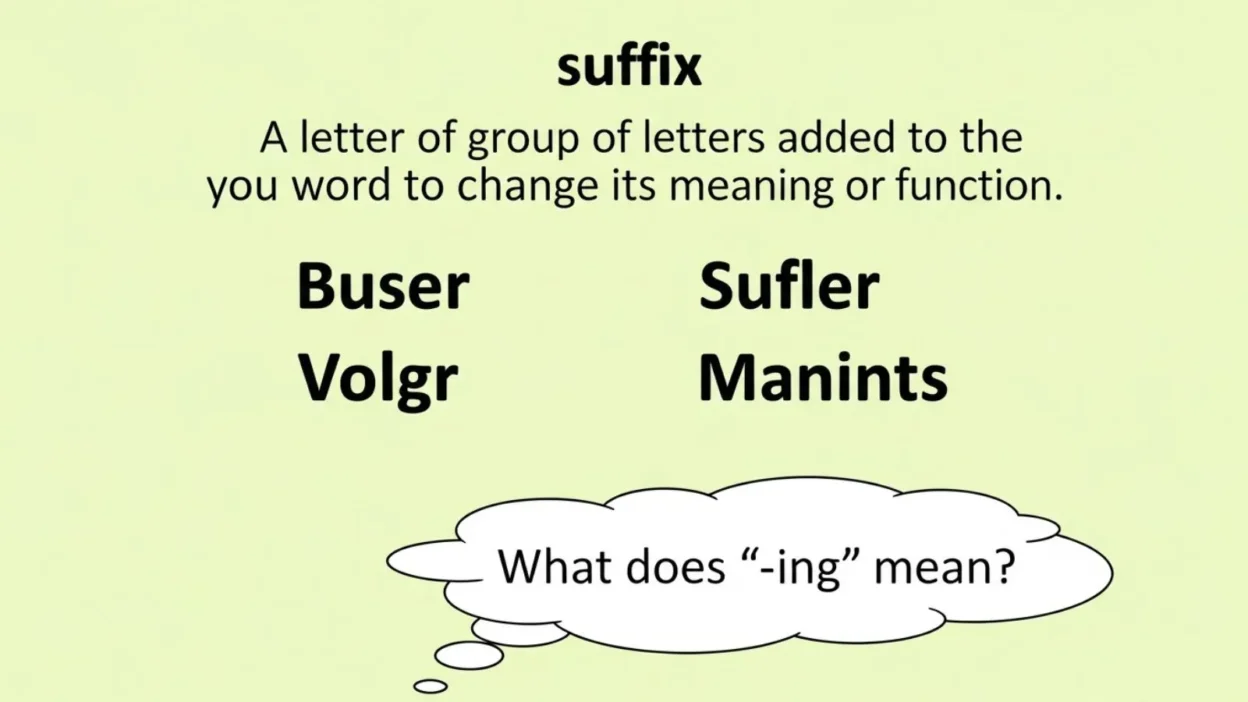
Have you ever wondered why the word happy becomes happiness or teach turns into teacher? The answer lies in suffixes. A suffix is a group of letters added to the end of a word that changes its meaning, function, or grammatical role.
Understanding suffixes is essential for improving vocabulary, reading comprehension, and writing skills.
In English, suffixes can transform nouns into adjectives, verbs into nouns, and adjectives into adverbs, allowing you to create new words and express ideas more precisely.
From everyday words like joyful and quickly to more complex forms like realization and beautiful, suffixes are everywhere.
In this article, we’ll explore the definition of a suffix, the types of suffixes, common rules, and practical examples to help you master their use.
What is a Suffix?
A suffix is a group of letters added to the end of a word to alter its meaning or grammatical function. Unlike a prefix, which is added to the beginning of a word, a suffix can change a word’s part of speech, tense, or even its tone. For example, adding -ness to the adjective happy forms the noun happiness, while adding -ful to beauty creates the adjective beautiful.
The term “suffix” comes from the Latin word suffixus, meaning “fastened under” or “attached at the end.” Over centuries, suffixes have become a vital part of the English language, allowing speakers and writers to form new words and express ideas more precisely.
Suffixes are not limited to a single function. Some create nouns (-ment, -ion), others form adjectives (-able, -ous), and some even convert words into verbs (-ify, -ize). Adverbs often use suffixes like -ly to indicate manner, as in quickly or happily.
Understanding suffixes is particularly important for learners of English, as it helps decode unfamiliar words. For instance, if you know that -er often turns a verb into a noun describing a person, you can deduce that teacher is “one who teaches.” In short, suffixes are small but powerful tools that enrich vocabulary, improve comprehension, and allow more flexible use of the language.
What’s a Suffix?

A suffix is a letter or group of letters added to the end of a word to change its meaning or grammatical role. Suffixes are commonly used in English to create new words, modify word forms, or show tense, quantity, or comparison. For example, adding -ful to the word help creates helpful, while adding -ly to quick forms quickly.
The word “suffix” originates from the Latin term suffixus, which means “attached below” or “added at the end.” Over time, suffixes became an essential part of English grammar and vocabulary formation. They allow speakers and writers to express ideas more clearly and expand language in a structured way.
Suffixes can serve many purposes in language. Some turn verbs into nouns, such as develop becoming development with the suffix -ment. Others create adjectives, like care changing to careless with -less. Certain suffixes also form adverbs, including slow becoming slowly through the addition of -ly.
Learning suffixes is helpful because it improves vocabulary and reading comprehension. When you understand common suffix meanings, it becomes easier to recognize unfamiliar words. For instance, knowing that -er often refers to a person who performs an action helps you understand words like writer, teacher, or singer.
In simple terms, suffixes are small additions that make language more flexible, descriptive, and meaningful. They play an important role in everyday communication and help build thousands of words used in English today.
Types of Suffixes
Suffixes in English are generally categorized based on the part of speech they create. Understanding these types helps learners identify how words can change meaning and function.
1. Noun Suffixes
Noun suffixes turn other words into nouns. Common examples include -ness, -ment, -ion, -er, and -ist.
For Instance:
- happy → happiness
- develop → development
- teach → teacher
- piano → pianist
These suffixes often describe qualities, actions, or people associated with a word.
2. Adjective Suffixes
Adjective suffixes create adjectives from nouns or verbs. Common endings are -able, -ful, -less, -ous, and -ic.
Examples include:
- beauty → beautiful
- care → careless
- danger → dangerous
These suffixes help describe qualities, abilities, or characteristics.
3. Verb Suffixes
Verb suffixes form verbs from nouns or adjectives. Common suffixes are -ize, -ify, -en, and -ate.
For example:
- modern → modernize
- pure → purify
- strength → strengthen
They often indicate actions or processes.
4. Adverb Suffixes
Adverbs usually use the suffix -ly to modify verbs, adjectives, or other adverbs:
- quick → quickly
- happy → happily
- careful → carefully
These suffixes tell how, when, or in what manner something happens.
Rules and Patterns of Suffixes
Adding a suffix to a word is not always as simple as attaching letters at the end. English has spelling rules and patterns that help maintain correct word forms. Knowing these rules is essential to write accurately and avoid common mistakes.
1. Dropping the Final ‘e’
When a word ends with an -e, it is often dropped before adding a vowel-based suffix.
- hope → hoping
- create → creation
However, if the suffix begins with a consonant, the -e usually stays: - care → careful
2. Doubling the Final Consonant
If a word has a short vowel followed by a single consonant, the consonant is doubled before adding a suffix that starts with a vowel.
- run → running
- begin → beginning
3. Changing ‘y’ to ‘i’
When a word ends with a consonant + y, the y is often changed to i before adding a suffix (except when adding -ing).
- happy → happiness
- beauty → beautiful
- But: play → playing (no change)
4. Common Exceptions
English has irregular forms and exceptions. For example, skill → skillful, not skilliful, and dye → dying, where the e is dropped differently.
How Suffixes Change Word Meaning
Suffixes are more than just letters added to words—they have the power to transform meaning, function, and nuance. By adding a suffix, a word can change from a verb to a noun, an adjective to an adverb, or even take on a completely new sense.
For example, consider the word teach. Adding the noun suffix -er creates teacher, meaning “one who teaches.” Similarly, the adjective happy becomes the noun happiness with the suffix -ness, shifting the focus from a quality to a concept. Verb suffixes also create action-based meanings: modern becomes modernize, indicating the process of making something modern.
Suffixes can also adjust intensity or tone. Adding -ish to a color word, like greenish, suggests something slightly green, whereas -ful as in beautiful emphasizes a strong positive quality. Adverbial suffixes like -ly describe how actions occur, turning quick into quickly, which specifies manner.
Understanding how suffixes alter meaning is especially useful in reading comprehension and vocabulary development. Even when encountering unfamiliar words, recognizing a common suffix can give clues to its function and meaning. For instance, words ending in -ology often refer to the “study of” something, like biology or geology.
In short, suffixes are powerful tools that expand language, allowing speakers to create new words, clarify meaning, and express ideas more precisely.
Common Mistakes with Suffixes
Even though suffixes are essential for creating and understanding words, many learners make common mistakes when using them. Being aware of these errors can help improve both writing and reading skills.
1. Confusing Similar Suffixes
Some suffixes have similar forms but different meanings, which can cause mistakes. For example:
- -ful means “full of” → joyful (full of joy)
- -less means “without” → joyless (without joy)
Using the wrong suffix can completely change the meaning of a word.
2. Incorrect Spelling Changes
When adding suffixes, spelling rules like dropping the final e or changing y to i are often ignored.
- Incorrect: happyness → Correct: happiness
- Incorrect: beautifuly → Correct: beautifully
3. Overusing Suffixes
Sometimes writers try to create words with multiple suffixes unnecessarily, which can confuse readers:
- Incorrect: teachershipness
- Correct: teachers or teaching
4. Misusing Verb and Noun Suffixes
Adding a suffix that changes a word’s part of speech incorrectly is another common mistake.
- Incorrect: strongify (nonexistent verb)
- Correct: strengthen
5. Ignoring Context
Suffixes may alter tone or formality. Using informal suffixes in formal writing, or vice versa, can create awkward sentences.
Practical Applications of Suffixes
Suffixes are not just grammatical tools—they have practical applications that make language more flexible and expressive. Understanding how to use suffixes can improve vocabulary, writing, reading comprehension, and communication skills.
1. Expanding Vocabulary
Knowing common suffixes allows you to create or understand new words. For example, if you know that -er often indicates a person, you can deduce that baker is “one who bakes” and runner is “one who runs.” Similarly, recognizing -ology as “the study of” helps you understand geology, psychology, and biology.
2. Improving Writing Skills
Suffixes help writers adjust tone, emphasis, and style. Adding -ful or -less can make writing more descriptive: joyful celebration vs. joyless event. Adverbial suffixes like -ly clarify how an action is performed: She spoke confidently.
3. Enhancing Reading Comprehension
Suffixes provide clues about a word’s meaning and function. Encountering happiness, you immediately know it’s a noun related to happy. This ability helps readers understand complex texts without constantly using a dictionary.
4. Learning and Teaching English
For learners of English, practicing suffixes systematically makes it easier to form words, infer meanings, and construct sentences correctly. Teachers often use suffix drills to reinforce grammar and vocabulary simultaneously.
Fun Facts and Trivia about Suffixes
Suffixes are not only practical—they also have fascinating histories and quirks that make learning them enjoyable. English suffixes often come from Latin, Greek, and Old English, reflecting the language’s rich, multicultural roots. For instance, the suffix -ology, meaning “the study of,” originates from Greek, appearing in words like biology, geology, and psychology.
Some suffixes have been borrowed from other languages over time. The suffix -able, meaning “capable of,” comes from Latin -abilis, while -ism, used to indicate doctrines or ideologies, also has Latin origins. These borrowed suffixes allow English speakers to form words that are precise, versatile, and globally recognizable.
Interestingly, suffixes can be very short or surprisingly long, yet still change a word completely. For example, -ish (as in greenish) slightly modifies meaning, while -ization (as in modernization) creates a formal noun from a verb. Some suffixes even carry tone or attitude: -y (as in cheeky) often adds informality or playfulness.
Another fun fact is that new suffixes continue to evolve. Modern technology and social media have popularized creative forms like -gate (as in Watergate → Cambridge Analytica-gate) to indicate scandals.
By exploring these fun facts, learners can appreciate not just the utility of suffixes, but also their cultural and historical significance, making language study more interesting and memorable.
Examples of Common Suffixes
Seeing suffixes in action makes it easier to understand how they change word meaning and function. Here are some common suffixes with examples:
1. Noun Suffixes
- -ness: happy → happiness → Her happiness was obvious.
- -ment: develop → development → The city’s development is impressive.
- -ion: act → action → His quick action saved the day.
- -er: teach → teacher → The teacher explained clearly.
2. Adjective Suffixes
- -ful: beauty → beautiful → She wore a beautiful dress.
- -less: care → careless → His careless mistake caused problems.
- -ous: danger → dangerous → It’s a dangerous road.
- -able: read → readable → The document is readable.
3. Verb Suffixes
- -ize: modern → modernize → They want to modernize the system.
- -ify: pure → purify → The water needs to be purified.
- -en: strength → strengthen → Exercises help strengthen muscles.
4. Adverb Suffixes
- -ly: quick → quickly → She ran quickly to catch the bus.
- -ward: back → backward → He looked backward to see the car.
- -wise: length → lengthwise → Cut the board lengthwise.
FAQs About Suffixes
1. What is a suffix in grammar?
A suffix is a group of letters added to the end of a word to change its meaning, part of speech, or grammatical function. For example, quick becomes quickly with the adverbial suffix -ly.
2. How does a suffix change a word?
Suffixes can turn verbs into nouns (teach → teacher), adjectives into nouns (happy → happiness), or adjectives into adverbs (quick → quickly). They modify meaning, tone, or grammatical use.
3. What are the most common suffixes in English?
Common suffixes include:
- Noun: -ness, -ment, -ion, -er
- Adjective: -ful, -less, -able, -ous
- Verb: -ize, -ify, -en
- Adverb: -ly, -ward, -wise
4. Can suffixes change the tense of a word?
Some verb suffixes indicate tense or aspect. For example, adding -ing forms the present participle (run → running), while -ed forms the past tense (walk → walked).
5. What is the difference between a suffix and a prefix?
A prefix is added to the beginning of a word (e.g., un- in unhappy), while a suffix is added to the end of a word (-ness in happiness). Both modify meaning, but in different positions.
6. How can I learn suffixes effectively?
- Memorize common suffixes and their meanings.
- Practice creating new words.
- Read and analyze words in context to recognize patterns.
Conclusion:
Suffixes are small yet powerful elements of the English language that transform words, alter meaning, and expand vocabulary.
By adding letters to the end of a word, we can create nouns, adjectives, verbs, and adverbs, allowing for more precise and versatile expression. Understanding suffixes also helps in decoding unfamiliar words, improving both reading comprehension and writing skills.
From common noun suffixes like ness and ment, to adjective endings like ful and less, verb suffixes such as ize and ify, and adverbial ly, mastering these patterns opens up countless possibilities for communication.
Awareness of spelling rules, common mistakes, and context ensures correct usage, while exploring fun facts about their origins makes learning engaging.
Ultimately, suffixes are not just grammar tools—they are essential building blocks for effective language use. By practicing and observing them in everyday reading and writing, anyone can enrich their vocabulary and communicate more clearly.

The author behind RiddleBurst.com loves creating fun, clever, and unique riddles for all ages. Their goal is to challenge minds, bring smiles, and make learning through riddles both engaging and enjoyable.