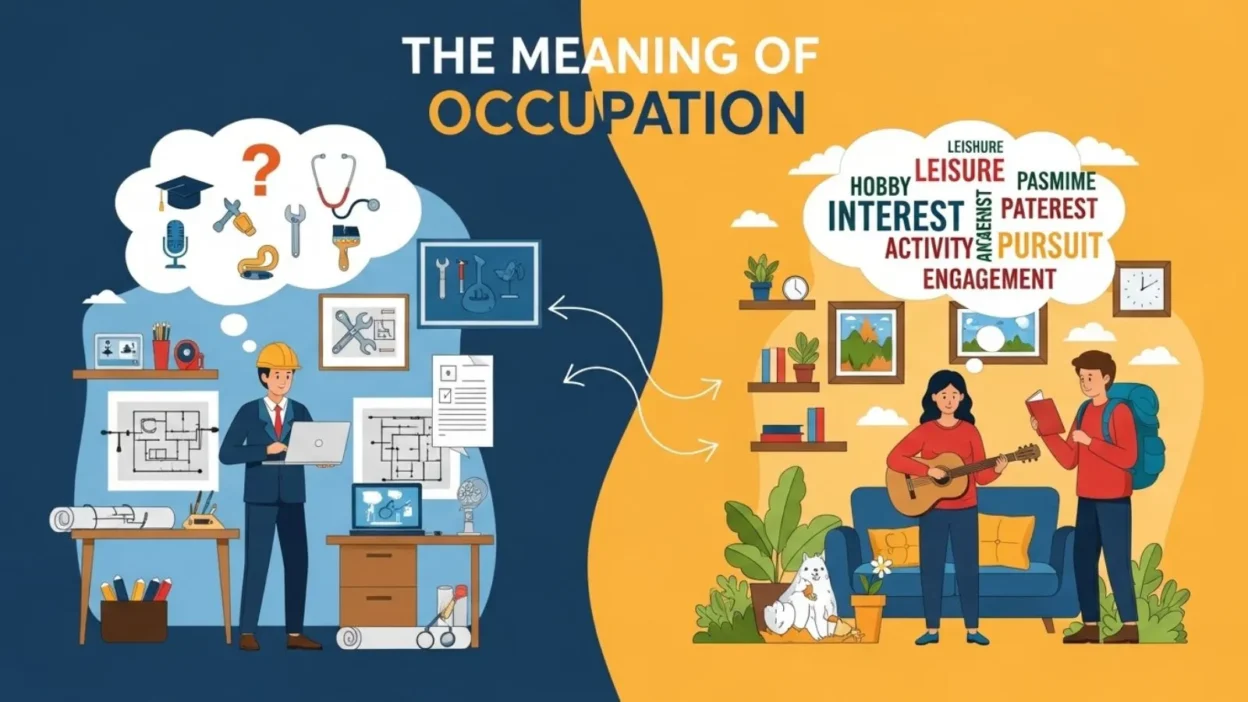
The term occupation is commonly used in everyday life, yet many people are unsure what it truly means. You may come across this word while filling out a job application, bank form, visa document, or school record.
In simple terms, occupation refers to the type of work or activity a person regularly does, especially to earn a living. However, its meaning can vary slightly depending on the context in which it is used.
Understanding what occupation means is important because it helps define a person’s professional role, social identity, and source of income.
If you are a student, employee, freelancer, homemaker, or unemployed, your occupation still describes how you spend your working time.
Many people also confuse occupation with similar terms such as job, profession, or employment, which can lead to mistakes on official forms.
In this article, we will explain the meaning of occupation in simple words, provide real-life examples, compare it with related terms, and clarify how to use it correctly in different situations.
What Does Occupation Mean?
The word occupation refers to the main activity or type of work a person regularly does, especially to earn money or support themselves. In simple terms, your occupation explains how you spend your working time or what kind of work you are engaged in. It is a broad term that focuses on the nature of your work rather than a specific job title or employer.
For example, if someone works as a math teacher at a private school, their occupation is teacher, not the name of the school. Similarly, if a person earns money by writing articles online, their occupation may be writer, freelancer, or content creator. This shows that occupation describes the general category of work, not the exact position.
The term occupation is often used in official and formal contexts such as government records, bank forms, visa applications, surveys, and census data. In these situations, institutions want to understand a person’s economic activity or employment status, which helps them collect accurate information for legal, financial, or statistical purposes.
Occupation does not always mean paid work. Students, homemakers, retirees, and even unemployed individuals can have an occupation based on their current status. For instance, a student’s occupation is commonly written as student, while a homemaker’s occupation may be listed as homemaker or household manager.
In short, occupation is a general term that explains what a person does on a regular basis, whether it is a profession, a trade, a role, or a life stage. Understanding this meaning helps you use the word correctly in both daily conversations and official documents.
Occupation Meaning in Simple Language
In simple language, occupation means the main thing a person does in their daily life, especially to earn money or stay productive. It answers the basic question: “What do you do?” When someone asks about your occupation, they are not asking for your company name or exact job title, but the general type of work or activity you are involved in.
For example, if a person repairs electrical wiring and installs lights, their occupation is electrician. If someone studies full-time at a college or university, their occupation is student. A person who manages household responsibilities without paid employment can write homemaker as their occupation. This makes the term easy to understand and widely applicable.
Occupation is a broad word, which means it covers many types of activities. It can include professional work, skilled labor, self-employment, part-time work, and even unpaid roles. That is why occupation is commonly used on forms and documents—it allows people from different backgrounds to describe what they do in a simple and standard way.
Using simple language, you can think of occupation as a label that describes how a person spends most of their working or productive time. It does not change based on where you work, but it can change when your role in life changes. For instance, a person may be a student today, an employee tomorrow, and a business owner in the future.
Overall, occupation is an easy and flexible term that helps explain a person’s work or role without going into unnecessary details. This simplicity makes it useful in everyday conversations as well as official situations.
Examples of Occupation
Understanding occupation becomes much easier when you look at real-life examples. An occupation describes the general type of work or role a person has, not the specific company or job position. People from different backgrounds and life stages can all have an occupation.
Common examples of occupation include teacher, doctor, engineer, lawyer, nurse, and accountant. These are professional occupations that usually require education or specialized training. Skilled workers also have occupations, such as electrician, plumber, carpenter, mechanic, and tailor, where hands-on skills are the main focus.
Modern work has introduced new occupation examples as well. People who earn income online may list their occupation as freelancer, content writer, graphic designer, digital marketer, YouTuber, or software developer. Self-employed individuals and business owners can write entrepreneur or business owner as their occupation.
Occupation is not limited to paid employment. A student can list student as their occupation because studying is their primary activity. A homemaker manages household duties and family responsibilities, which is also considered an occupation. Retired individuals may write retired, while those currently without work may write unemployed or seeking employment, depending on the form’s options.
Some people have more than one occupation. For example, a person may work as a teacher during the day and run an online business in the evening. In such cases, the main source of income is usually listed as the primary occupation.
These examples show that occupation is a flexible term. It adapts to different lifestyles, careers, and stages of life, making it useful in both everyday communication and official records.
What Is Your Occupation?
The question “What is your occupation?” is commonly asked in conversations, interviews, and official forms. It is meant to identify the general type of work or main activity you are involved in, not your exact job title or the name of the organization you work for. In simple words, this question asks how you spend your working or productive time.
When answering this question, it is best to give a clear and broad response. For example, instead of saying “I work at XYZ Company,” you would say teacher, sales executive, software developer, or business owner. This helps the listener or organization understand your role without needing extra details.
People often encounter this question on bank forms, visa applications, school admissions, surveys, and government documents. Institutions ask about occupation to understand a person’s employment status, income source, or social category. Providing an accurate answer is important because incorrect information can cause confusion or delays in processing documents.
If you are a student, you can confidently answer student as your occupation. If you manage household responsibilities, homemaker is an acceptable and widely used response. Retired individuals can answer retired, while those not currently working may write unemployed or seeking employment, depending on the available options.
In everyday conversation, this question is also used to learn more about someone’s background and interests. Overall, answering “What is your occupation?” correctly means choosing a simple term that clearly describes your main role or activity in life at the present time.
Occupation Meaning on Forms and Official Documents
The word occupation often appears on official forms, applications, and documents. Understanding what it means in these contexts is important to avoid mistakes. On forms, occupation is used to describe your primary role or work activity, not the company you work for or your exact job title. This helps institutions, such as banks, government agencies, or schools, collect accurate information about your employment status and economic activity.
For example, on a bank account application, the form may ask, “Occupation.” Here, you should write teacher, engineer, student, homemaker, or business owner, depending on your main role. Similarly, visa and immigration forms ask for occupation to understand your professional background and financial stability. Accurate answers ensure smooth processing and prevent delays.
Occupation on official documents is flexible and can include unpaid roles. A student can list student as an occupation. A homemaker can write homemaker or household manager. Retired individuals may use retired, while unemployed people may use unemployed or job seeker. In cases where someone has multiple roles, the main source of income or primary activity is generally listed as the occupation.
Many people make mistakes by writing vague terms, their employer’s name, or income instead of their occupation. This can lead to confusion or rejection of documents. The key is to use a clear, general term that accurately represents what you do on a regular basis. By understanding occupation in official contexts, you can provide precise information and avoid common errors.
Occupation vs Job vs Profession
Many people confuse occupation, job, and profession, but each term has a distinct meaning. Understanding the differences helps you answer questions correctly on forms, in interviews, or during conversations.
An occupation is a broad term that describes the general type of work a person does. It focuses on the category of work rather than the specific role. For example, a teacher, engineer, or doctor is an occupation. Occupation is used widely in official documents, surveys, and forms because it is flexible and applies to almost everyone, including students, homemakers, and retirees.
A job, on the other hand, is more specific. It refers to the position a person holds within a company or organization. For instance, a software developer at Google has a job title of software developer, but their occupation is a programmer or IT professional. Jobs are usually tied to employers and can change more frequently than occupations.
A profession is a type of occupation that typically requires specialized education, training, or certification. Examples include lawyers, doctors, engineers, and teachers. While all professions are occupations, not all occupations are considered professions.
To summarize, occupation describes the general type of work, job is the specific position, and profession is a specialized category that requires expertise. Understanding these differences ensures that you provide accurate information on forms, during interviews, or in everyday conversations. By using the right term, you can clearly communicate your role, skills, and professional identity.
Types of Occupations
Occupations can be categorized into different types based on the nature of work, skill level, and industry. Understanding these types helps to clarify what a person does and provides a better picture of the workforce.
1. Skilled Occupations:
These jobs require specific training, education, or expertise. Examples include electricians, carpenters, engineers, chefs, and nurses. Skilled occupations often involve technical knowledge or hands-on abilities and may require certifications or licenses.
2. Unskilled Occupations:
These roles typically do not require formal training or advanced education. Examples include cleaners, laborers, delivery workers, and farmhands. While unskilled occupations may not need specialized skills, they are essential for the smooth functioning of society and businesses.
3. White-Collar Occupations:
These occupations involve professional, managerial, or administrative work. Examples include teachers, accountants, office managers, lawyers, and IT professionals. White-collar occupations are usually performed in office environments and often require higher education or specialized skills.
4. Blue-Collar Occupations:
These are manual labor jobs that may involve physical work or technical expertise. Examples include mechanics, construction workers, plumbers, and factory workers. Blue-collar jobs are essential to infrastructure, manufacturing, and services.
5. Self-Employed Occupations:
People who run their own business or work independently fall into this category. Examples include freelancers, entrepreneurs, consultants, and online content creators. Self-employed occupations provide flexibility but often require discipline and business management skills.
Primary Occupation vs Secondary Occupation
A person can sometimes have more than one occupation, which is why it’s important to understand the difference between primary occupation and secondary occupation. These terms help clarify which activity is the main source of work or income and which is additional or part-time.
The primary occupation is the main activity or work that a person does on a regular basis, often providing the primary source of income or defining their professional identity. For example, if someone works full-time as a teacher, teaching is considered their primary occupation. It is usually the occupation listed on official forms, applications, or surveys because it represents the person’s main role.
The secondary occupation is any additional work or role that a person performs alongside their primary occupation. This could be part-time jobs, freelance work, hobbies that generate income, or seasonal work. For instance, a full-time teacher who writes articles for an online magazine or runs a small tutoring business in the evenings would have writing or tutoring as a secondary occupation. Secondary occupations are generally not required on most official forms, but they are useful for understanding a person’s total work activity or for economic surveys.
Having multiple occupations is common today, especially with freelancing, remote work, and side businesses becoming popular. Accurately distinguishing between primary and secondary occupations ensures clarity when reporting work status, filling forms, or describing professional roles in resumes and interviews.
In short, the primary occupation is your main work, while secondary occupations are additional roles you may perform alongside it. Both reflect your activities but serve different purposes in official and practical contexts.
Can Occupation Change Over Time?
Yes, a person’s occupation can change over time. Life is dynamic, and people often move through different roles, careers, and responsibilities as they grow, learn new skills, or face changing circumstances. Understanding that occupation is not always permanent helps explain why it is a flexible and broad term.
Many factors can lead to a change in occupation. Education and training are common reasons—students may become professionals after completing their studies, such as a student turning into a teacher, engineer, or nurse. Similarly, someone may gain new certifications or skills that allow them to move from one type of work to another, like a mechanic learning IT skills and becoming a software technician.
Career advancement or job switching can also lead to occupational changes. A person may start as a junior employee in one role but eventually move into management, entrepreneurship, or consultancy. Economic factors, such as demand for certain skills or industries, can influence these changes as well.
Life circumstances like retirement, family responsibilities, or relocation may also affect occupation. For example, a full-time professional may become a homemaker for some years or take up part-time work. Freelancers and self-employed individuals often juggle multiple occupations, which can evolve over time depending on opportunities.
Overall, occupation is a flexible concept that adapts to personal growth, life changes, and economic conditions. Recognizing that occupations can change helps individuals plan their careers, answer forms accurately, and understand their evolving role in society. It also reinforces that occupation describes what a person does at a given stage of life, rather than a fixed identity.
Why Occupation Is Important
Occupation plays a significant role in a person’s life, far beyond just earning money. It helps define identity, provides financial stability, and influences social status. Understanding its importance makes it clear why people are often asked about their occupation on forms, surveys, or in conversations.
First, occupation contributes to a person’s identity and self-esteem. Many people identify themselves by what they do regularly, such as calling themselves a teacher, engineer, or doctor. Even students, homemakers, and retirees associate their daily routines and roles with their current occupation. It shapes how others perceive them and how they perceive themselves.
Second, occupation is important for financial security and lifestyle. A person’s work often determines their income, standard of living, and access to benefits such as healthcare, retirement plans, and social support. For instance, a skilled professional may have higher income potential compared to an unskilled worker, affecting lifestyle choices and long-term financial planning.
Third, occupation is critical in legal, official, and administrative contexts. Governments, banks, schools, and other institutions ask for occupation to verify employment, assess eligibility, and maintain accurate records. Occupation data also helps in surveys, statistics, and research that inform economic and social policies.
Finally, occupation influences personal growth and social contribution. Through work, people develop skills, build networks, and contribute to society, whether in professional, manual, or volunteer roles.
In short, occupation is more than a label; it reflects identity, income, social role, and personal contribution. Understanding its importance ensures people use the term accurately and appreciate its broader impact on life and society.
Common Mistakes People Make About Occupation
Many people make mistakes when describing their occupation, especially on forms, applications, or in conversations. These errors can lead to confusion, delays, or misinterpretation of their professional status. Understanding these common mistakes helps ensure accuracy and clarity.
One frequent mistake is confusing occupation with job title. For example, writing “Software Developer at XYZ Company” as an occupation is incorrect because occupation refers to the general type of work, not the specific employer. The correct response would simply be Software Developer or IT Professional.
Another common error is writing income or salary instead of occupation. Some people write “$50,000 per year” or “earning $1000 weekly” in the occupation field. Occupation is about what you do, not how much you earn. Writing income instead can cause misunderstandings, especially on official forms.
People also often leave the occupation field blank or write vague terms like “worker” or “job.” While these words are not wrong, they are too general and do not clearly describe the type of work being done. Using specific and recognized terms is always better.
Another mistake is confusing occupation with profession. Not every occupation is a profession. For instance, homemakers, students, and freelancers are occupations but not necessarily professions.
Finally, people sometimes forget to update their occupation after a life change. For example, a student who has started a full-time job should update their occupation to reflect their current work.
Avoiding these mistakes ensures your occupation is accurately represented, whether on official documents, surveys, or in everyday conversations. Clear and precise information prevents confusion and reflects your true role or activity.
Occupation Meaning in Different Contexts
The meaning of occupation can vary depending on the context in which it is used. While the general definition refers to a person’s main work or activity, understanding how it applies in different areas helps clarify its usage.
In daily life, occupation simply describes what a person does regularly. For example, a student’s occupation is student, a full-time teacher’s occupation is teacher, and a homemaker’s occupation is homemaker. This context focuses on everyday activity and how people spend their productive time.
In economics, occupation refers to the role a person plays in the workforce. Economists use occupation data to analyze labor markets, income distribution, and employment trends. For instance, categorizing workers as professionals, skilled laborers, or unskilled workers helps understand economic patterns and workforce needs.
In sociology, occupation reflects social identity and status. A person’s occupation can influence their social class, lifestyle, and societal role. For example, doctors and engineers may be associated with higher social status, while other occupations may reflect different social roles or community contributions.
In history, occupation can describe the work people performed in different eras, showing how labor and professional roles evolved over time. For example, blacksmiths, scribes, and cobblers were common occupations in past centuries.
In legal and official contexts, occupation is used to verify employment, determine eligibility for benefits, or complete formal records. Forms such as visas, bank accounts, and census documents often require accurate occupation information.
Overall, occupation is a versatile term. Its core meaning remains consistent, but its interpretation can change depending on social, economic, historical, or legal context, making it an important and widely applicable concept.
FAQs About Occupation
1. What does occupation mean in a form?
On forms, occupation refers to the main work or activity you do regularly. It is usually a general term like teacher, student, homemaker, or engineer, rather than the name of your employer or specific job title.
2. Can a student write student as their occupation?
Yes. Students are considered to have an occupation because studying is their primary activity. Writing “student” accurately reflects your current role.
3. Is homemaker an occupation?
Yes. Managing household responsibilities full-time is recognized as an occupation. You can write homemaker or household manager on forms or official documents.
4. Is unemployed considered an occupation?
While being unemployed is not a traditional occupation, some forms allow you to write unemployed or seeking employment to indicate your current status. This clarifies your situation without leaving the field blank.
5. Can someone have more than one occupation?
Yes. People often have a primary occupation and a secondary occupation, such as a full-time teacher who also runs an online business. The primary occupation is usually listed on official documents.
6. What is the difference between occupation, job, and profession?
Occupation is a broad term describing your main type of work. A job is the specific position you hold in an organization. A profession is a specialized occupation that requires education or training, like doctor, lawyer, or engineer.
Conclusion:
Understanding the meaning of occupation is essential in both everyday life and official contexts.
At its core, occupation refers to the main activity or type of work a person regularly performs, if it is paid employment, studying, managing a household, or even being temporarily unemployed.
It is a broad and flexible term that applies to people at different stages of life and across various industries.
Occupation is important because it defines a person’s role, identity, and source of income, and it is frequently required on forms, applications, surveys, and official documents.
By knowing the correct way to describe your occupation, you can avoid common mistakes, such as confusing occupation with job title, employer name, or income.
It also helps in distinguishing between primary and secondary occupations, understanding types of occupations, and comparing occupation with job and profession.
A student today may become a teacher tomorrow, while someone running a small business may also take up freelancing as a secondary occupation.
In summary, occupation is more than just a label it reflects your daily work, social role, and personal contribution to society. Accurately describing it ensures clarity, professionalism, and understanding in both personal and official situations.

The author behind RiddleBurst.com loves creating fun, clever, and unique riddles for all ages. Their goal is to challenge minds, bring smiles, and make learning through riddles both engaging and enjoyable.