Have you ever wondered what an ion is and why it’s important in our daily lives? In simple terms, an ion is an atom or molecule that carries an electric charge because it has gained or lost one or more electrons.
This tiny change in electrons might seem small, but it has huge effects in chemistry, biology, and technology.
For example, the salt we sprinkle on our food contains ions like Na⁺ (sodium) and Cl⁻ (chloride), which dissolve in water and play a crucial role in chemical reactions.
In the human body, ions such as potassium, calcium, and magnesium are essential for nerve signals, muscle movement, and maintaining the right balance of fluids.
Even batteries and electronics rely on ions to function. Understanding what ions are gives us a peek into the invisible world of charged particles that shape everything from the food we eat to the technology we use.
What Is an Ion?
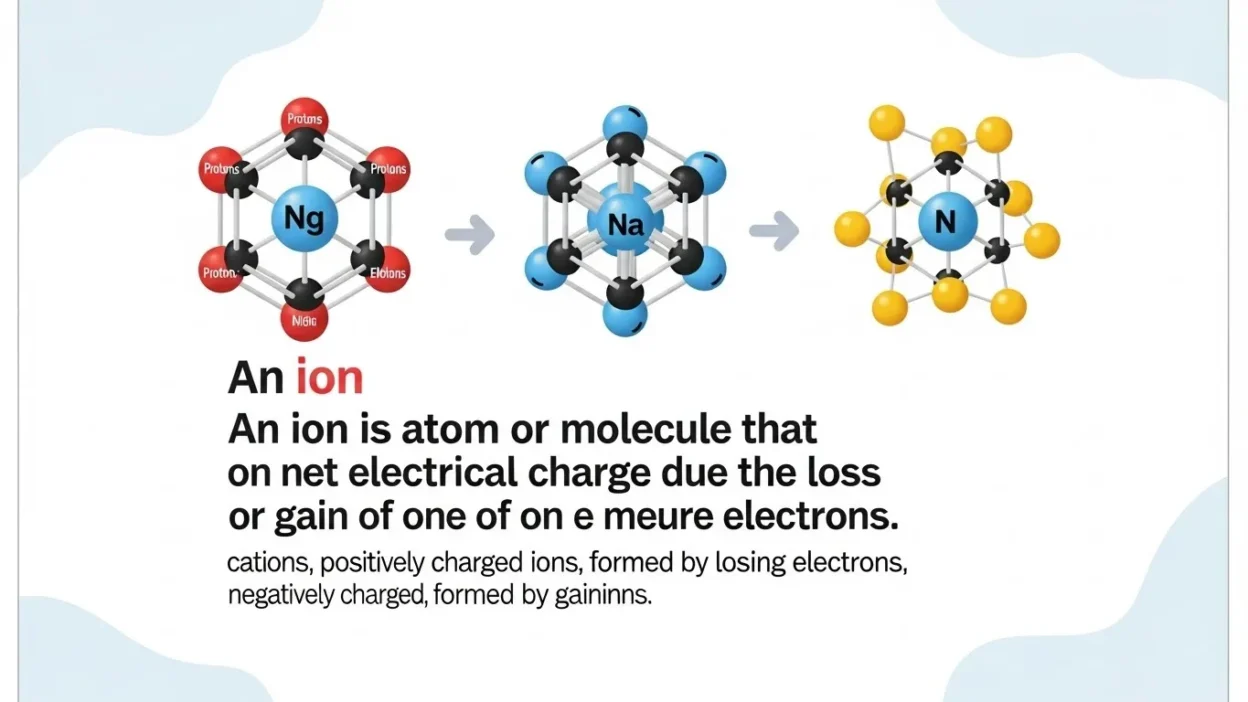
An ion is essentially an atom or molecule that has a net electrical charge due to the gain or loss of electrons. Normally, atoms are electrically neutral because they have an equal number of protons (positive charges) and electrons (negative charges). However, when an atom loses one or more electrons, it becomes a positively charged ion, called a cation. Conversely, when it gains extra electrons, it becomes a negatively charged ion, known as an anion.
For example, a sodium atom (Na) can lose one electron to form a Na⁺ ion, while a chlorine atom (Cl) can gain an electron to form a Cl⁻ ion. When these two ions come together, they form the familiar table salt (NaCl).
Ions are not just limited to simple atoms. Molecules can also become ions, forming polyatomic ions like NH₄⁺ (ammonium) or SO₄²⁻ (sulfate), which are common in chemistry and everyday life.
A simple analogy helps make this concept easier to visualize: imagine atoms as tiny Lego blocks. Normally, each block has a balanced set of connectors. When a block loses or gains connectors (electrons), it becomes “charged” and can attract or bond with other blocks differently.
Understanding ions is fundamental to chemistry, biology, and physics because these charged particles influence chemical reactions, electricity, and even biological processes. Without ions, life and many technologies we rely on would not exist.
Types of Ions
Ions come in different types depending on their electrical charge and structure. The two main categories are cations and anions, and there are also polyatomic ions, which are made of multiple atoms.
Cations are positively charged ions. They form when an atom loses one or more electrons. For example, sodium (Na⁺) and calcium (Ca²⁺) are cations commonly found in food, water, and the human body. These ions are essential for functions such as nerve impulses and muscle contraction.
Anions are negatively charged ions. They form when an atom gains extra electrons. Examples include chloride (Cl⁻), hydroxide (OH⁻), and sulfate (SO₄²⁻). Anions play a key role in chemical reactions, maintaining fluid balance, and forming salts.
In addition to single-atom ions, there are polyatomic ions, which are ions made of two or more atoms bonded together that act as a single charged unit. Common examples include ammonium (NH₄⁺), carbonate (CO₃²⁻), and nitrate (NO₃⁻). These ions are found in fertilizers, cleaning products, and biological systems.
A helpful way to remember the difference: cations are “pawsitive” (positive), and anions are “negative”. Polyatomic ions are like a team of atoms moving together, carrying a single charge.
Understanding the types of ions helps us grasp how ionic compounds form, how reactions happen, and why ions are vital in daily life, from cooking to electronics to biology.
How Ions Are Formed
Ions are formed when atoms gain or lose electrons, creating a net electrical charge. This process is central to chemistry and explains why ions behave differently from neutral atoms.
One common way ions form is through electron transfer between atoms. For example, in table salt (NaCl), a sodium atom (Na) has one electron in its outer shell, while a chlorine atom (Cl) needs one electron to complete its shell. Sodium loses its electron, becoming a Na⁺ cation, and chlorine gains that electron, becoming a Cl⁻ anion. The opposite charges attract, forming an ionic bond and creating a stable compound.
Ions can also form in polyatomic molecules, where multiple atoms share or gain/lose electrons together. Examples include ammonium (NH₄⁺) or carbonate (CO₃²⁻), which are essential in fertilizers, water treatment, and biological systems.
Another method of ion formation is dissociation in water. Certain compounds, like salts, acids, and bases, break apart into ions when dissolved. For instance, NaCl dissolves in water to form Na⁺ and Cl⁻ ions, enabling it to conduct electricity.
Even in gases, ions can form through ionization, where high energy strips electrons from atoms, creating charged particles. This process occurs naturally in lightning, stars, and even in the upper atmosphere.
In short, ions are formed through electron transfer, chemical reactions, or energy input, and their formation underlies many chemical, biological, and technological processes we encounter every day.
Next, I can write the fifth section (~250 words) “Importance of Ions”, covering chemistry, biology, and technology applications.
Shall I continue with that?
next and 250 word count
Perfect! Here’s the fifth section (~250 words) for your blog, covering “Importance of Ions” and their roles in chemistry, biology, and technology:
Importance of Ions
Ions play a vital role in many aspects of life, science, and technology. Without them, chemical reactions, biological processes, and even modern devices wouldn’t function properly.
In chemistry, ions are essential because they enable the formation of ionic compounds. For example, salts, acids, and bases are made up of cations and anions that combine through ionic bonds. These charged particles determine the solubility, reactivity, and stability of compounds. Many reactions, such as acid-base neutralization or electrolysis, rely directly on the presence of ions to proceed.
In biology, ions are critical for maintaining life. Electrolytes like sodium (Na⁺), potassium (K⁺), calcium (Ca²⁺), and magnesium (Mg²⁺) help transmit nerve impulses, control muscle contractions, and regulate fluid balance in the body. Even small imbalances in these ions can lead to serious health problems, highlighting their importance.
In technology, ions are equally indispensable. Batteries, for instance, rely on ions moving between electrodes to produce electricity. Electrolysis, water purification, and many industrial processes also depend on ions to work efficiently. Even the operation of modern electronics often involves ionized materials to function correctly.
Beyond these areas, ions are found everywhere—from the salt in our food to ions in the air around waterfalls, which some studies suggest can have a refreshing effect. Understanding ions helps us appreciate their ubiquity and essential role in the natural world, our health, and the devices we use daily.
Common Examples of Ions
Ions are all around us, both in nature and in our daily lives. Understanding common examples helps illustrate their importance and functions.
One of the most familiar ions is sodium (Na⁺), a positively charged ion found in table salt (NaCl). When salt dissolves in water, it separates into Na⁺ and Cl⁻ ions, which are essential for nerve signaling, hydration, and muscle function. Similarly, potassium (K⁺) is a vital cation in fruits like bananas, helping regulate heartbeats and fluid balance.
On the negative side, chloride (Cl⁻) is a common anion that pairs with cations to form salts, while hydroxide (OH⁻) plays a crucial role in bases and chemical reactions. Another important anion is carbonate (CO₃²⁻), found in baking soda and minerals, which helps regulate acidity in both cooking and natural water systems.
Polyatomic ions like ammonium (NH₄⁺) and nitrate (NO₃⁻) are widely used in fertilizers, supporting plant growth and agriculture. Even beverages contain ions; for example, sports drinks are rich in electrolytes, including Na⁺, K⁺, and Mg²⁺, to replenish minerals lost through sweat.
Ions are not just in food and water—they are also present in the air. Negative ions are found near waterfalls, oceans, and forests, while positive ions are often produced by electronics. These charged particles can subtly affect mood and energy levels.
In short, ions are everywhere, from the food we eat to the environment around us, demonstrating their crucial role in both life and technology.
Fun Facts / Interesting Tidbits About Ions
Ions may seem like a purely scientific concept, but they also have fascinating roles in everyday life and the natural world. For starters, ions are the reason why water can conduct electricity. When salts dissolve in water, they break into cations and anions, allowing electric currents to pass through—a principle used in batteries and electrolysis.
Another interesting fact is that our bodies are full of ions. Electrolytes like sodium (Na⁺), potassium (K⁺), calcium (Ca²⁺), and magnesium (Mg²⁺) are essential for keeping nerves firing, muscles moving, and even the heart beating. Sports drinks are designed specifically to replenish these ions after exercise, highlighting their importance in health and fitness.
Ions also exist in the environment. Negative ions are often found near waterfalls, oceans, and forests, where they are believed to boost mood, energy, and overall well-being. Positive ions, on the other hand, are more common around electronic devices and crowded indoor spaces, which may contribute to feelings of fatigue or stress.
Beyond daily life, ions play a crucial role in industry and technology. From fertilizers like ammonium nitrate (NH₄NO₃) to water purification systems, ions help make processes more efficient and effective. Even lightning is a dramatic display of ions moving through the air!
These tidbits show that ions are not just abstract science—they are everywhere, impacting our health, the environment, and the technology we rely on every day. Understanding them can make you appreciate the hidden charged particles that power life and the world around us.
Ions vs. Atoms and Electrons
To fully understand ions, it helps to compare them to neutral atoms and electrons. Atoms are the basic units of matter, made up of protons, neutrons, and electrons. In a neutral atom, the number of protons (positive charges) equals the number of electrons (negative charges), so the overall charge is zero.
Ions, on the other hand, are atoms or molecules that have lost or gained electrons, giving them a net positive or negative charge. For example, when a sodium atom (Na) loses one electron, it becomes Na⁺, a positively charged cation. When a chlorine atom (Cl) gains an electron, it becomes Cl⁻, a negatively charged anion. These charged particles behave differently from neutral atoms, attracting or repelling other ions and forming ionic compounds.
Electrons themselves are tiny negatively charged particles within atoms. While an atom may have multiple electrons, ions are specifically defined by an imbalance in electron number, which changes the atom or molecule’s behavior.
A simple analogy: think of an atom as a balanced seesaw, with equal weight on both sides. Losing or gaining an electron tilts the seesaw, creating a “charge” that influences how the particle interacts with others.
Understanding these differences is crucial because ions drive chemical reactions, electrical conductivity, and biological processes, while neutral atoms remain relatively stable. Electrons are the key players in forming ions, making them the invisible architects of many phenomena we encounter daily.
FAQs About Ions
1. What is an ion?
An ion is an atom or molecule that carries an electric charge due to gaining or losing electrons. Positive ions are called cations, and negative ions are called anions.
2. How are ions formed?
Ions are formed when atoms gain or lose electrons. This can happen through electron transfer, chemical reactions, or dissociation in water.
3. What are the types of ions?
The main types of ions are:
- Cations: positively charged (e.g., Na⁺, Ca²⁺)
- Anions: negatively charged (e.g., Cl⁻, OH⁻)
- Polyatomic ions: ions made of multiple atoms (e.g., NH₄⁺, SO₄²⁻)
4. Why are ions important in the human body?
Ions like sodium, potassium, calcium, and magnesium help transmit nerve signals, regulate heartbeat, control muscle contractions, and maintain fluid balance.
5. Can ions be found in everyday life?
Yes! Ions are present in table salt, sports drinks, water, air, and even electronics. They play roles in health, cooking, and technology.
6. What is the difference between an ion and an atom?
A neutral atom has equal numbers of protons and electrons, resulting in no net charge. An ion has an imbalance of electrons, giving it a positive or negative charge.
7. Are ions dangerous?
Most ions are safe and essential for life. However, toxic ions like lead (Pb²⁺) or mercury (Hg²⁺) can be harmful if ingested or inhaled.
8. What are some common examples of ions?
Common examples include Na⁺, K⁺, Ca²⁺, Cl⁻, OH⁻, CO₃²⁻, NH₄⁺, and NO₃⁻. They appear in food, water, the environment, and technology.
Conclusion:
Ions may be tiny, but their impact on our world is enormous. Simply put, an ion is an atom or molecule that carries an electric charge due to gaining or losing electrons.
This small shift in electrons allows ions to interact in ways that neutral atoms cannot, making them essential in chemistry, biology, and technology.
In daily life, ions are everywhere. The salt on our table, the electrolytes in sports drinks, and even the negative ions in the air around waterfalls all play roles that affect our health and environment.
In the human body, ions like sodium, potassium, calcium, and magnesium keep our nerves firing, muscles contracting, and fluids balanced. Without them, life as we know it wouldn’t be possible.
Ions are equally important in the scientific and industrial world. They form ionic compounds, drive chemical reactions, conduct electricity in solutions, and power batteries and electronics.
Polyatomic ions like ammonium and nitrate are crucial in agriculture, cleaning, and water treatment.
Understanding ions also helps us make sense of the invisible processes happening all around us, from electricity flowing through circuits to chemical reactions in cooking and medicine.
In short, ions are the charged building blocks of life and technology, linking the microscopic world of electrons to the macroscopic effects we see every day. Learning about ions not only enhances our scientific knowledge but also helps us appreciate the hidden forces shaping our world.
Discover More Articles:
- What Does Suffix Mean? A Complete Guide for Beginners
- What Does HM Mean? Text Abbreviation Explained
- What Does Pendejo Mean? Is It an Insult or Just Slang?