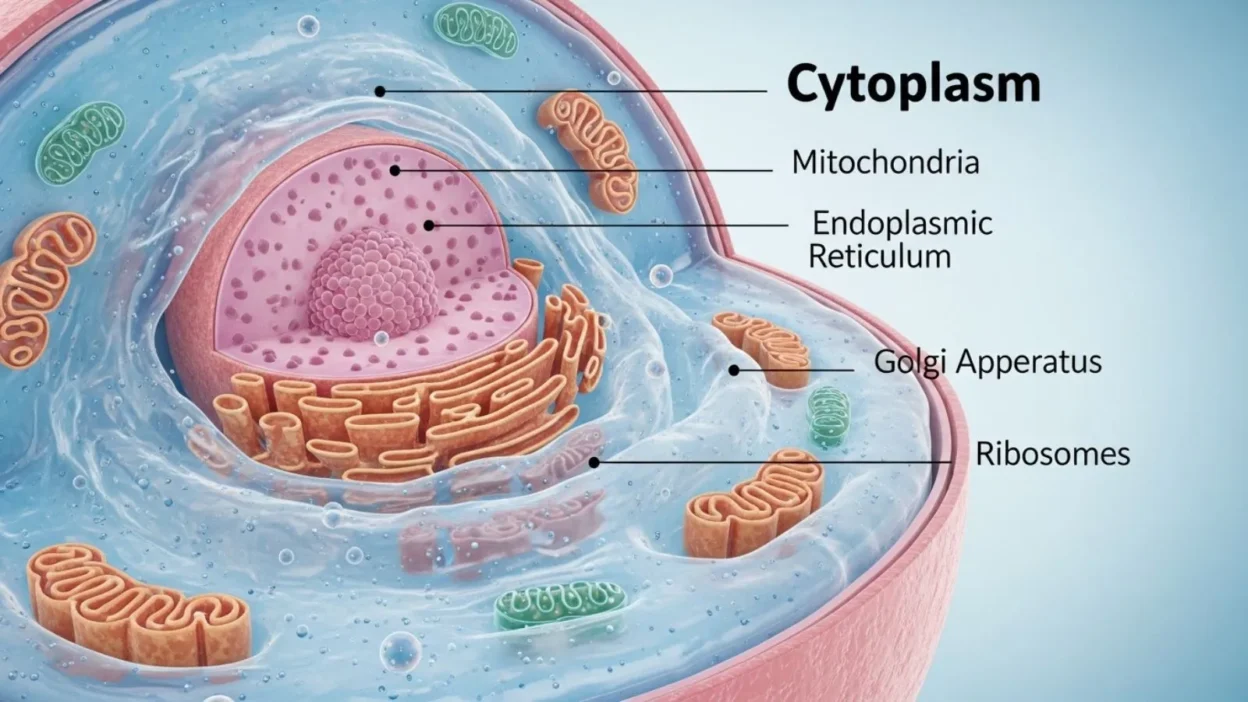
The cytoplasm is one of the most important yet often overlooked parts of a cell. Sometimes described as a jelly like substance, it fills the space between the cell membrane and the nucleus, providing a dynamic environment where countless cellular activities take place.
But what does the cytoplasm actually do, and why is it so essential for life? Understanding the cytoplasm is key to grasping how cells function, grow, and survive.
Inside this remarkable structure, organelles like mitochondria, ribosomes, and the endoplasmic reticulum are suspended, and a variety of chemical reactions necessary for life occur.
The cytoplasm not only supports and protects these organelles but also acts as a medium for transporting nutrients, enzymes, and proteins throughout the cell.
In short, it plays a central role in maintaining the life and health of every living cell.
What is Cytoplasm?
Cytoplasm is the gel-like substance that fills the interior of a cell, lying between the cell membrane and the nucleus. It is primarily made up of water, salts, proteins, and other molecules, forming a medium known as cytosol in which cellular organelles are suspended. While often used interchangeably with cytosol, cytoplasm technically includes both the cytosol and the organelles it surrounds. This distinction is important for understanding cell biology, as the cytosol is where many biochemical reactions occur, while the cytoplasm provides the overall structure and environment for these processes.
The cytoplasm exists in both eukaryotic and prokaryotic cells, although its composition can vary slightly. In animal and plant cells, it serves as the site for many metabolic activities, including glycolysis and the initial steps of protein synthesis. In prokaryotic cells, which lack a defined nucleus, the cytoplasm holds DNA, ribosomes, and enzymes in a highly organized yet flexible environment.
Physically, the cytoplasm is neither completely solid nor fully liquid; it has a gel-like consistency that allows it to support organelles while still enabling movement within the cell. This unique property facilitates processes such as cytoplasmic streaming, which helps distribute nutrients, organelles, and other materials efficiently throughout the cell. By providing structure, medium, and support, the cytoplasm ensures that the cell functions smoothly and effectively.
Major Functions of the Cytoplasm
The cytoplasm plays several essential roles that are critical to the survival and proper functioning of a cell. One of its primary functions is to act as a transport medium, moving nutrients, enzymes, and other molecules between different parts of the cell. This movement ensures that organelles such as mitochondria, ribosomes, and the endoplasmic reticulum receive the materials they need to perform their specific tasks efficiently.
Another key function of the cytoplasm is to serve as the site for chemical reactions. Many metabolic processes, including glycolysis and the early stages of protein synthesis, occur within the cytosol, the fluid portion of the cytoplasm. These reactions are vital for generating energy and producing molecules essential for the cell’s growth and repair.
The cytoplasm also provides structural support to the cell. Its gel-like consistency helps maintain the cell’s shape and stabilizes organelles, preventing them from collapsing or clustering together. Additionally, it serves as a storage area for nutrients, ions, and waste products, allowing the cell to regulate its internal environment effectively.
Finally, the cytoplasm acts as a protective buffer, absorbing shocks and shielding delicate organelles from damage. Its dynamic environment enables cytoplasmic streaming, a process that distributes materials evenly and keeps the cell functioning smoothly. By combining these roles, the cytoplasm is often described as the “life-supporting jelly” of the cell, ensuring that all cellular processes continue without interruption.
Cytoplasm and Organelles
The cytoplasm is more than just a passive filler in the cell—it actively interacts with organelles, ensuring that each one can function efficiently. Organelles such as the nucleus, mitochondria, ribosomes, endoplasmic reticulum, and Golgi apparatus are all suspended within the cytoplasm, which provides both support and a medium for communication. Without the cytoplasm, these organelles would lack the stability and mobility required to perform their tasks effectively.
One of the main roles of the cytoplasm is to facilitate metabolic processes. Enzymes and molecules dissolved in the cytosol carry out vital chemical reactions, such as protein synthesis at ribosomes and energy production in mitochondria. The cytoplasm ensures that reactants and enzymes are in close proximity, which accelerates these reactions and helps maintain cellular efficiency.
The cytoplasm also acts as a transport network. Materials like proteins, lipids, and waste products move through the cytoplasm to reach organelles or exit the cell. Processes like cytoplasmic streaming allow for even distribution of nutrients and organelles, preventing congestion and ensuring all parts of the cell receive what they need.
Additionally, the cytoplasm provides a protective environment, shielding delicate organelles from sudden changes in the external environment, toxins, or mechanical stress. In essence, the cytoplasm functions as both the scaffolding and the circulatory system of the cell, coordinating organelle activity and maintaining cellular life.
Importance of Cytoplasm in Cells
The cytoplasm is vital to a cell’s survival and overall function, making it one of the most important components of life. One of its primary roles is maintaining cellular homeostasis, which is the balance of the internal environment. By regulating the distribution of nutrients, ions, and molecules, the cytoplasm ensures that chemical reactions occur under optimal conditions. This balance is crucial for energy production, protein synthesis, and other life-sustaining processes.
The cytoplasm also plays a key role in cell growth and division. During mitosis, the cytoplasm helps evenly distribute organelles and cytosolic contents between daughter cells. Its gel-like consistency allows organelles to move and adjust as the cell changes shape, ensuring smooth division and proper cellular function.
In addition, the cytoplasm facilitates intracellular signaling. Molecules such as hormones, enzymes, and secondary messengers travel through the cytoplasm to relay messages between organelles. This communication is critical for coordinating processes such as metabolism, gene expression, and response to environmental changes.
Another important function of the cytoplasm is its protective role. Acting as a buffer, it shields delicate organelles from physical shocks, sudden chemical changes, or harmful substances. This protective environment is essential for maintaining the integrity and longevity of the cell.
In summary, the cytoplasm is far more than a filler material—it is a dynamic, life-supporting environment that sustains growth, enables communication, protects organelles, and ensures the smooth functioning of every cellular process.
Cytoplasm in Different Types of Cells
The cytoplasm exists in all cell types, but its structure and roles can vary depending on whether the cell is eukaryotic or prokaryotic, and whether it is a plant or animal cell. In eukaryotic cells, such as animal and plant cells, the cytoplasm provides a medium for organelles to be suspended and perform specialized functions. In animal cells, it supports organelles like mitochondria, the endoplasmic reticulum, and ribosomes, allowing for processes like protein synthesis and energy production. In plant cells, the cytoplasm interacts closely with large vacuoles and chloroplasts, facilitating photosynthesis and storage of nutrients.
In prokaryotic cells, which lack a nucleus, the cytoplasm is even more critical. It holds the DNA, ribosomes, and enzymes in a highly organized environment despite the absence of membrane-bound organelles. This ensures that essential processes like protein synthesis, metabolism, and replication occur efficiently.
Specialized cells also demonstrate unique cytoplasmic adaptations. For example, in muscle cells, the cytoplasm—referred to as sarcoplasm—stores glycogen and other molecules to provide energy for contraction. In nerve cells, the cytoplasm supports long axons and aids the transport of neurotransmitters and cellular materials across large distances within the cell.
Overall, while the cytoplasm’s basic composition remains similar, its role and importance are tailored to the cell type, allowing every cell to function optimally. Understanding these variations helps explain how cells perform specialized tasks while relying on the cytoplasm as their life-supporting medium.
Interesting Facts About Cytoplasm
While the cytoplasm might seem like a simple, jelly-like filler in cells, it is actually full of fascinating properties and functions that highlight its critical role in life. One interesting feature is cytoplasmic streaming, particularly in plant cells. This process involves the movement of the cytoplasm around the cell, helping to distribute nutrients, organelles, and other materials evenly. Cytoplasmic streaming ensures that even large plant cells can maintain efficient internal transport, keeping all parts of the cell supplied and functional.
Another remarkable aspect of the cytoplasm is its dynamic consistency. It is neither a solid nor a liquid but has a gel-like structure that allows organelles to move while still providing support. This flexibility is essential for processes such as cell division, intracellular transport, and the response to environmental changes.
The cytoplasm also acts as a buffer and protector. It shields delicate organelles from sudden chemical changes, mechanical shocks, or toxic substances, ensuring that the cell continues functioning smoothly.
Additionally, the cytoplasm is home to numerous enzymes and molecules that drive vital chemical reactions, making it the site of much of the cell’s metabolic activity. In specialized cells, such as muscle cells (sarcoplasm) or nerve cells, the cytoplasm adapts to store energy molecules or support long-distance transport of materials.
In short, the cytoplasm is more than just a passive filler—it is a living, active environment that keeps cells organized, nourished, and ready to respond to any challenge, making it one of the most fascinating components of cellular biology.
FAQs About Cytoplasm
1. What is cytoplasm made of?
Cytoplasm is primarily composed of water, salts, proteins, and other organic molecules. It contains cytosol (the fluid part) as well as organelles, inclusions, and cytoplasmic filaments that help maintain cell structure and support metabolic reactions.
2. What is the difference between cytoplasm and cytosol?
Cytosol is the liquid portion of the cytoplasm, where most chemical reactions occur. Cytoplasm includes both the cytosol and the organelles suspended within it, making it the entire living material inside the cell, excluding the nucleus.
3. Can cells survive without cytoplasm?
No. The cytoplasm is essential for supporting organelles, facilitating chemical reactions, transporting molecules, and maintaining cell structure. Without it, cells cannot perform vital functions or sustain life.
4. What is the role of cytoplasm in plant and animal cells?
In both plant and animal cells, the cytoplasm provides a medium for organelles, enables chemical reactions, supports the cell’s structure, and transports materials. In plant cells, it also interacts with vacuoles and chloroplasts to assist in photosynthesis and nutrient storage.
5. Is cytoplasm alive?
Cytoplasm itself is not alive, but it is a living part of the cell, creating an active environment where organelles function and essential life processes occur.
Conclusion:
The cytoplasm is often called the unsung hero of the cell, yet it plays a central role in keeping every cell alive and functional.
Far more than just a jelly like filler, it serves as a dynamic environment where organelles are suspended, chemical reactions take place, and materials are transported efficiently.
From maintaining cell structure and protecting delicate organelles to supporting metabolism, protein synthesis, and cell division, the cytoplasm is essential for virtually every life-sustaining process.
Its presence in all cell types from plant and animal cells to prokaryotic bacteria demonstrates its universal importance, while specialized adaptations, like cytoplasmic streaming or energy storage in muscle cells, show its versatility.
Understanding the cytoplasm helps us appreciate how cells operate as highly organized, self sustaining units of life. Ultimately, the cytoplasm is more than just part of a cell; it is a living, active medium that sustains life, connects organelles, and ensures that every cellular process runs smoothly.

The author behind RiddleBurst.com loves creating fun, clever, and unique riddles for all ages. Their goal is to challenge minds, bring smiles, and make learning through riddles both engaging and enjoyable.