
When you’re driving and a warning light suddenly appears on your dashboard, it can be confusing and even a little worrying. One of the most common lights drivers notice is the ABS light, yet many drivers are unsure what it actually means or why it matters.
ABS stands for Anti lock Braking System, a vital safety feature designed to help you maintain control of your vehicle during sudden or emergency braking.
Instead of allowing the wheels to lock up and skid, the system automatically adjusts brake pressure to keep the tires gripping the road.
This technology plays an important role in reducing the risk of accidents, especially on wet, slippery, or uneven surfaces.
Understanding how ABS works and what its warning light indicates can help you react calmly and make safer driving decisions.
In this guide, you’ll learn what ABS means on a car, how it works, why it’s important for safety, and what steps to take if the ABS light turns on.
What Does ABS Stand For?
ABS stands for Anti-lock Braking System, an advanced safety feature built into most modern vehicles to improve control during braking. The main purpose of ABS is to prevent a car’s wheels from locking up when the driver applies the brakes suddenly or forcefully. When wheels lock, they stop rotating and begin to slide across the road surface, which can cause the driver to lose steering control and increase the risk of skidding or accidents. ABS helps avoid this dangerous situation by automatically managing brake pressure.
In a traditional braking system without ABS, pressing the brake pedal hard can cause the tires to lose traction, especially on wet, icy, or loose roads. Once traction is lost, the driver may not be able to steer the vehicle effectively. ABS solves this problem by rapidly applying and releasing brake pressure multiple times per second. This process allows the wheels to continue rotating while still slowing the vehicle down, helping the tires maintain grip on the road.
The Anti-lock Braking System works automatically and does not require any special action from the driver. When ABS activates, drivers may feel a slight vibration or pulsing in the brake pedal — this is completely normal and indicates the system is functioning correctly. Today, ABS is considered a standard safety feature in cars worldwide because it significantly improves vehicle stability and steering control during emergency braking situations, making driving safer for both drivers and passengers.
How ABS Works in a Car
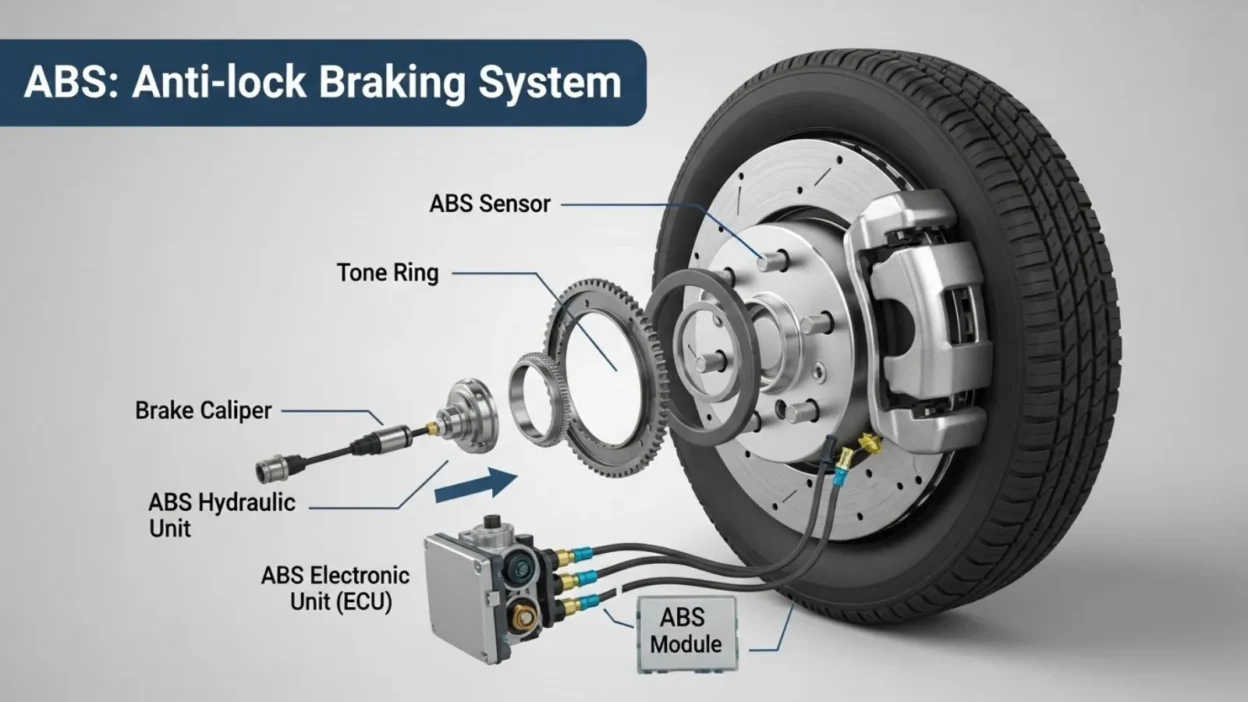
The Anti-lock Braking System works by using a combination of sensors, electronic controls, and hydraulic components to prevent the wheels from locking during hard braking. Its goal is simple: allow the driver to slow down quickly while still maintaining steering control. The system constantly monitors how fast each wheel is rotating and reacts instantly if it detects a problem.
Each wheel has a wheel speed sensor that sends real-time data to the car’s ABS control module, which acts like a small computer. When you press the brake pedal suddenly, the control module checks whether any wheel is slowing down faster than the others — a sign that it may lock up and start skidding. If this happens, the system automatically reduces brake pressure to that specific wheel.
Hydraulic valves and a pump inside the ABS unit rapidly adjust the braking force by applying and releasing pressure many times per second. This rapid pulsing happens much faster than a human driver could pump the brakes manually. As a result, the tires keep rotating instead of sliding, allowing the driver to steer around obstacles while braking.
When ABS activates, you may feel vibrations in the brake pedal or hear a clicking or grinding sound. This sensation can surprise new drivers, but it simply means the system is working properly. By maintaining tire traction and vehicle stability, ABS helps drivers stay in control during emergency stops, especially on slippery roads or during sudden hazards.
Why ABS Is Important for Vehicle Safety
The Anti-lock Braking System plays a major role in improving overall vehicle safety, especially during sudden or emergency braking situations. One of the biggest dangers while braking hard is wheel lockup, which occurs when the tires stop rotating and begin sliding across the road. When this happens, drivers often lose steering control, making it difficult or impossible to avoid obstacles. ABS helps prevent this by keeping the wheels rotating while slowing the vehicle down.
One of the key safety advantages of ABS is that it allows drivers to steer while braking. In an emergency, such as when a pedestrian suddenly crosses the road or another vehicle stops unexpectedly, drivers often need to brake and change direction at the same time. Without ABS, locked wheels can cause the car to skid straight ahead. With ABS active, the tires maintain traction, allowing the driver to maneuver safely around hazards.
ABS is particularly helpful on wet, icy, or uneven road surfaces where traction is naturally reduced. By automatically adjusting brake pressure, the system reduces the chances of skidding and improves vehicle stability. Although ABS does not always shorten stopping distance on loose surfaces like gravel or snow, it greatly improves control, which is often more important for avoiding accidents.
Because of these safety benefits, ABS has become a standard feature in modern vehicles worldwide. It works silently in the background, ready to assist drivers when quick reactions and maximum control are needed most.
Understanding the ABS Warning Light
The ABS warning light on your dashboard is your car’s way of alerting you to potential issues with the Anti-lock Braking System. This light usually appears as a yellow or amber circle with the letters “ABS” inside, often accompanied by parentheses representing wheels. When you first start your car, it may briefly illuminate as the system performs a self-check — this is normal. However, if the ABS light stays on while driving, it indicates that there may be a problem that needs attention.
A constantly illuminated ABS light does not mean your regular brakes will stop working. You can still apply the brakes and bring the vehicle to a halt. However, the anti-lock feature itself may be disabled, meaning the system may not prevent wheel lockup in emergency braking situations. Driving with a malfunctioning ABS increases the risk of skidding, especially on wet or slippery roads, so it’s important not to ignore the warning.
Common triggers for the ABS light include faulty wheel speed sensors, low brake fluid, damaged wiring, a blown fuse, or a malfunctioning ABS control module. Sometimes, the issue can be minor and easy to fix, such as cleaning a sensor or topping up brake fluid. Other times, it may require professional inspection and repair.
By understanding what the ABS warning light means, you can respond calmly and safely. It serves as an early alert to maintain vehicle safety and avoid more serious braking problems in the future. Regular vehicle maintenance and prompt attention to warning lights ensure that your ABS system continues to function properly when you need it most.
Common Causes of the ABS Light Turning On
The ABS warning light can turn on for a variety of reasons, ranging from simple maintenance issues to more serious system malfunctions. Understanding these common causes can help you troubleshoot the problem and decide whether you can address it yourself or need professional help.
One of the most frequent causes is a faulty wheel speed sensor. Each wheel has a sensor that monitors its rotation, and if a sensor fails or becomes dirty, it can send incorrect information to the ABS control module, triggering the warning light. Cleaning or replacing the sensor often resolves the issue.
Another common reason is low brake fluid. The ABS system relies on hydraulic pressure to operate correctly, and if fluid levels drop due to leaks or worn brake pads, the system may not function properly, illuminating the ABS light. Regularly checking and topping up brake fluid can prevent this.
Damaged wiring or connectors can also cause ABS problems. Corrosion, frayed wires, or loose connections can interrupt signals between the sensors and control module, resulting in the light turning on. In some cases, a blown fuse related to the ABS circuit can be the culprit.
Lastly, ABS module failure or internal malfunctions in the braking system can trigger the warning light. While this is less common, it often requires a professional diagnostic scan and repair.
It’s important to remember that while your normal brakes will still work, the anti-lock feature may be disabled whenever the ABS light is on. Prompt attention ensures you maintain safety, especially on slippery roads or during emergency braking situations. Regular maintenance and timely repairs help keep your ABS system reliable and effective.
Is It Safe to Drive With the ABS Light On?
Seeing the ABS warning light illuminated on your dashboard can be concerning, and it naturally raises the question: is it safe to continue driving? The short answer is that your car’s regular braking system will still work, but the anti-lock feature itself may be disabled. This means that in situations where ABS would normally prevent wheel lockup, such as sudden stops or slippery roads, your ability to steer while braking could be compromised.
Driving with a malfunctioning ABS system is generally safe under normal, everyday conditions, such as dry pavement and light traffic. However, caution is essential. Avoid aggressive or sudden braking, as the wheels can lock more easily without ABS support. Keep extra distance between your car and vehicles in front of you, and reduce speed when road conditions are poor, such as during rain, snow, or ice.
There are scenarios where driving with the ABS light on becomes risky. Emergency braking situations, steep declines, or slippery surfaces increase the likelihood of skidding or loss of control. If you encounter any of these conditions, it’s safer to have your ABS system inspected and repaired before driving extensively.
To ensure long-term safety, it’s best to schedule a professional diagnostic check as soon as possible. Mechanics can identify whether the issue is a minor sensor problem, a fluid-related concern, or a more significant module failure. While the car remains drivable, addressing ABS problems promptly helps maintain maximum braking performance and ensures you’re prepared for unexpected hazards on the road.
How ABS Helps in Different Road Conditions
The Anti-lock Braking System is especially valuable because it adapts to a variety of road conditions, helping drivers maintain control in situations where conventional braking might fail. ABS is designed to prevent wheel lockup and improve steering, which can make a critical difference on wet, icy, or uneven surfaces.
On wet roads, ABS reduces the risk of hydroplaning by keeping the tires rotating and maintaining contact with the road. During sudden braking on a rainy day, the system allows the driver to steer around obstacles while slowing down safely. Without ABS, the wheels might lock, causing the car to skid uncontrollably.
In snow or icy conditions, traction is naturally limited, and locked wheels are more likely to slide. ABS helps by pulsing the brakes rapidly, allowing the wheels to keep moving and providing better control. Although stopping distances may still be longer on ice compared to dry roads, the ability to steer can prevent collisions.
On loose surfaces such as gravel or sand, ABS behavior can differ slightly. Some drivers may notice slightly longer stopping distances, but the system still improves stability and reduces the risk of sudden wheel lockup.
Even during highway emergency stops, ABS is invaluable. A driver can brake hard while avoiding other vehicles or obstacles, maintaining control when every fraction of a second matters.
By keeping wheels in motion and optimizing brake pressure automatically, ABS ensures that the car responds more predictably in varied road conditions. Understanding how it performs across different surfaces helps drivers trust the system and react more confidently in emergencies.
Signs Your ABS System May Be Failing
Even though ABS is designed to operate silently in the background, there are several clear signs that indicate the system may not be functioning properly. Recognizing these early can prevent unsafe driving situations and costly repairs.
One of the most obvious signs is the ABS warning light staying on continuously after the car has started. While the light normally appears briefly during a self-check, a persistent illumination means the system has detected a problem. Another common indicator is unusual behavior in the brake pedal, such as vibrations, pulsations, or a spongy feel when braking. While some pulsing is normal when ABS activates, irregular or excessive feedback may suggest a malfunction.
Drivers might also notice longer stopping distances than usual, particularly in wet or slippery conditions. If the vehicle skids or feels unstable during hard braking, it could indicate that ABS is not maintaining wheel traction effectively. Strange noises, such as grinding or clicking that occurs outside of normal ABS activation, can also point to sensor or module issues.
Other less obvious signs include intermittent ABS light flickering or the system engaging when brakes are applied gently on normal surfaces. Electrical problems, corroded wiring, or failing wheel speed sensors are often the culprits behind these symptoms.
Paying attention to these warning signs and addressing them promptly is essential. While your regular brakes may still function, a failing ABS compromises your ability to steer safely during emergencies, increasing the risk of accidents. Regular inspections, professional diagnostics, and timely repairs ensure that the ABS system remains reliable and effective when you need it most.
How ABS Problems Are Diagnosed
When the ABS warning light comes on, it’s important to identify the root cause of the issue as quickly as possible. Diagnosing ABS problems typically involves a combination of visual inspections, electronic testing, and professional diagnostic tools to ensure the system functions correctly.
The first step mechanics usually take is a visual inspection of the braking system. They check the brake fluid level, look for leaks, examine brake pads, and inspect the wheel speed sensors and wiring for signs of damage or corrosion. Even minor issues like dirt buildup on a sensor can trigger the ABS light.
Next, a diagnostic scan tool is often connected to the car’s onboard computer (OBD-II system) to read ABS-specific error codes. These codes provide detailed information about which part of the system is malfunctioning, such as a faulty sensor, an ABS module issue, or electrical problems. This allows the mechanic to pinpoint the problem without unnecessary parts replacement.
In some cases, the mechanic may test individual components manually. For example, wheel speed sensors can be checked for proper signal output, and the ABS module can be assessed for proper function. They may also test brake pressure and perform road tests under controlled conditions to verify the system’s response.
Timely diagnosis is crucial because while normal braking may still work, the ABS system’s failure reduces your ability to maintain control during emergency stops or on slippery roads. Once the problem is identified, appropriate repairs or replacements can restore full ABS functionality, keeping both the vehicle and driver safe.
How to Fix ABS Issues
Fixing ABS issues depends on identifying the exact cause of the problem. Some problems are minor and can be addressed quickly, while others require professional repair or replacement of system components. Understanding common solutions can help you maintain your vehicle’s braking safety.
One of the simplest fixes is checking and topping up brake fluid. Since ABS relies on hydraulic pressure, low fluid levels can trigger the warning light. Ensuring your brake fluid is at the correct level often resolves the issue. Another common solution is cleaning or replacing wheel speed sensors. Dirt, debris, or corrosion on the sensors can interfere with signals to the ABS control module, causing the system to malfunction. Cleaning or installing new sensors usually restores proper operation.
Inspecting wiring and connectors is also important. Frayed wires, loose connections, or corrosion can prevent signals from reaching the ABS module. Repairing or replacing damaged wiring can eliminate ABS warning light problems. Occasionally, a blown fuse in the ABS circuit may be the culprit; replacing the fuse is a simple and inexpensive fix.
More complex problems, such as a malfunctioning ABS control module, often require professional diagnostics and repair. Modern vehicles rely on computer-controlled braking systems, and specialized tools are needed to program or replace modules correctly.
It’s essential to address ABS problems promptly. While your standard brakes may still work, driving without a functioning ABS increases the risk of wheel lockup during sudden braking or on slippery surfaces. Timely maintenance ensures that your ABS system continues to provide the safety benefits it was designed for, keeping you in control under emergency conditions.
ABS Maintenance Tips
Regular maintenance is key to ensuring your Anti-lock Braking System remains reliable and effective. By taking a few proactive steps, you can prevent ABS problems and extend the life of your braking system.
First, regular brake inspections are essential. Have a certified mechanic check your brake pads, rotors, and fluid levels periodically. Worn brake components can affect ABS performance, and early detection helps avoid unexpected failures. Ensuring that the brake fluid is at the correct level and free of contaminants is particularly important, as ABS relies on hydraulic pressure to operate properly.
Second, keep wheel speed sensors clean. These sensors detect the rotation of each wheel and communicate with the ABS control module. Dirt, debris, or corrosion on the sensors can interfere with signals and trigger the warning light. Cleaning or checking sensors during routine brake maintenance helps avoid unnecessary ABS activation or failures.
Tire maintenance is another critical factor. Uneven or worn tires can affect wheel speed readings, which may cause the ABS system to malfunction. Rotating tires regularly and maintaining proper tire pressure ensures consistent contact with the road, improving both ABS effectiveness and overall vehicle safety.
Lastly, follow the manufacturer’s recommended service schedule for brake system maintenance, including brake fluid replacement. Modern ABS systems are sensitive to fluid quality and pressure, so timely servicing prevents malfunctions and keeps the system responsive.
By combining these maintenance practices with careful driving habits, you can ensure that your ABS system continues to function correctly, providing enhanced braking performance and improved safety on all road conditions.
Common Myths About ABS
Despite being a standard safety feature in modern vehicles, the Anti-lock Braking System is often misunderstood. Several common myths can cause drivers to misuse their brakes or misunderstand how ABS works, so it’s important to separate fact from fiction.
One widespread myth is that ABS always shortens stopping distance. While ABS helps maintain control during hard braking, it does not necessarily reduce stopping distances on all surfaces. On loose surfaces like gravel or snow, stopping distances may actually be slightly longer, though control and stability are still improved.
Another misconception is that ABS prevents all skids. ABS can help prevent wheel lockup, but it cannot defy the laws of physics. Drivers can still skid if they exceed safe speeds for road conditions or brake too aggressively on extremely slippery surfaces.
Some drivers also believe that pumping the brakes is still necessary with ABS. In reality, ABS automatically pulses the brakes much faster than any human could, making manual pumping unnecessary. Attempting to pump the brakes while ABS is active can actually reduce the system’s effectiveness.
Finally, some think ABS works perfectly on every surface. While ABS improves control in most conditions, extremely uneven, icy, or loose surfaces can still challenge the system. Drivers should always adjust speed and driving style according to road conditions, even with ABS engaged.
Understanding these myths helps drivers use ABS correctly and safely. Recognizing its capabilities and limitations ensures that the system provides maximum benefit without creating overconfidence or misuse during emergency braking situations. Proper knowledge of ABS contributes to safer driving habits and more effective vehicle control.
ABS and Other Car Safety Systems
The Anti-lock Braking System (ABS) is just one component of a broader network of vehicle safety technologies. Understanding how ABS interacts with other systems can help drivers appreciate the full scope of modern automotive safety and how these features work together to prevent accidents.
One system closely linked to ABS is Traction Control. Traction control prevents wheel spin during acceleration by adjusting engine power or applying brakes to individual wheels. Because it relies on the same wheel speed sensors used by ABS, these systems often work in tandem. When ABS prevents wheel lockup during braking, traction control prevents excessive spinning during acceleration, providing smoother and safer handling in slippery conditions.
Another complementary system is Electronic Stability Control (ESC). ESC monitors the vehicle’s movement and detects if it’s beginning to skid or slide. If the car starts to lose control, ESC can automatically apply brakes to individual wheels and reduce engine power to help the driver maintain stability. ABS is essential to ESC because it allows selective braking without locking the wheels, enabling the system to correct skids effectively.
Brake Assist systems are also integrated with ABS in many vehicles. Brake Assist detects emergency braking situations and applies additional braking force automatically to reduce stopping distance. Again, ABS ensures that this added pressure doesn’t cause wheel lockup.
By working together, ABS, traction control, ESC, and brake assist provide multiple layers of protection. Each system enhances the other’s effectiveness, improving vehicle stability, control, and overall safety. Understanding these interactions helps drivers trust the technology and respond confidently during emergency situations, knowing their vehicle has systems designed to keep them in control.
Advantages and Disadvantages of ABS
The Anti-lock Braking System offers several important advantages that enhance vehicle safety, but it also has a few limitations that drivers should understand.
Advantages
One of the main benefits of ABS is improved steering control during emergency braking. Unlike traditional brakes, which can lock up the wheels and cause skidding, ABS allows the wheels to keep rotating. This lets drivers steer around obstacles while slowing down, reducing the likelihood of collisions.
Another key advantage is enhanced stability, especially on slippery or uneven road surfaces. By automatically adjusting brake pressure, ABS helps maintain traction, preventing the car from sliding or spinning out during sudden stops. It also reduces the risk of wheel lockup, which can be dangerous in wet or icy conditions.
ABS can also increase driver confidence. Knowing that the system is ready to assist in emergency braking allows drivers to react more calmly under stressful situations, improving overall road safety.
Disadvantages
However, ABS is not without limitations. On loose surfaces like gravel, sand, or deep snow, ABS may slightly increase stopping distances because the system prevents wheel lockup, which sometimes helps tires dig into loose material for more friction.
Another potential downside is repair and maintenance costs. ABS components such as sensors, wiring, or the control module can be expensive to replace if they fail.
Finally, some drivers develop overconfidence in ABS, expecting the system to prevent all accidents. While ABS greatly enhances control, it does not make a vehicle invincible; safe driving practices are still essential.
Overall, the advantages of ABS far outweigh the disadvantages, especially for emergency situations and slippery conditions. Awareness of its limitations ensures drivers use the system effectively while maintaining safe driving habits.
Frequently Asked Questions (FAQs) About ABS
1. What happens if ABS stops working?
If the ABS system fails, your standard brakes will still function, but the anti-lock feature will be disabled. This increases the risk of wheel lockup during emergency braking, especially on slippery roads.
2. Can I drive without ABS?
Yes, but caution is required. Without ABS, you must avoid hard braking on wet, icy, or loose surfaces, and be prepared for longer stopping distances and reduced steering control during sudden stops.
3. Why does my ABS activate at low speed?
ABS is designed to activate only when the system detects wheel lockup. If it engages at low speeds, it may indicate a sensor issue or a malfunction in the ABS module. A professional diagnostic check is recommended.
4. Does ABS work without traction control?
Yes. ABS and traction control are separate systems. ABS prevents wheel lockup during braking, while traction control prevents wheel spin during acceleration. Both systems may share sensors but operate independently.
5. Can ABS be turned off?
Most modern cars do not allow ABS to be turned off for safety reasons. Some older vehicles may have a switch, but disabling ABS is not recommended.
6. Is ABS required by law?
In many countries, ABS is a standard safety feature for new cars. It is widely recognized as a critical system for preventing skids and improving emergency braking performance.
Conclusion:
The Anti-lock Braking System (ABS) is one of the most important safety features in modern vehicles.
Its primary function is to prevent wheel lockup during sudden or emergency braking, allowing drivers to maintain steering control and improve vehicle stability.
Understanding what ABS means on a car, how it works, and how it interacts with other safety systems helps drivers respond safely when the ABS warning light appears or when conditions on the road become challenging.
ABS provides significant advantages, including enhanced steering control, better traction on slippery roads, and improved confidence during emergency stops.
It works seamlessly with other systems like traction control, electronic stability control, and brake assist, creating multiple layers of safety for drivers and passengers alike.
While ABS has a few limitations, such as slightly longer stopping distances on loose surfaces and potential repair costs, its overall benefits in preventing accidents far outweigh these drawbacks.
Regular maintenance is crucial to keep the ABS system functioning correctly. Checking brake fluid, inspecting wheel speed sensors, keeping tires in good condition, and addressing any warning lights promptly ensures that the system remains reliable.

The author behind RiddleBurst.com loves creating fun, clever, and unique riddles for all ages. Their goal is to challenge minds, bring smiles, and make learning through riddles both engaging and enjoyable.