
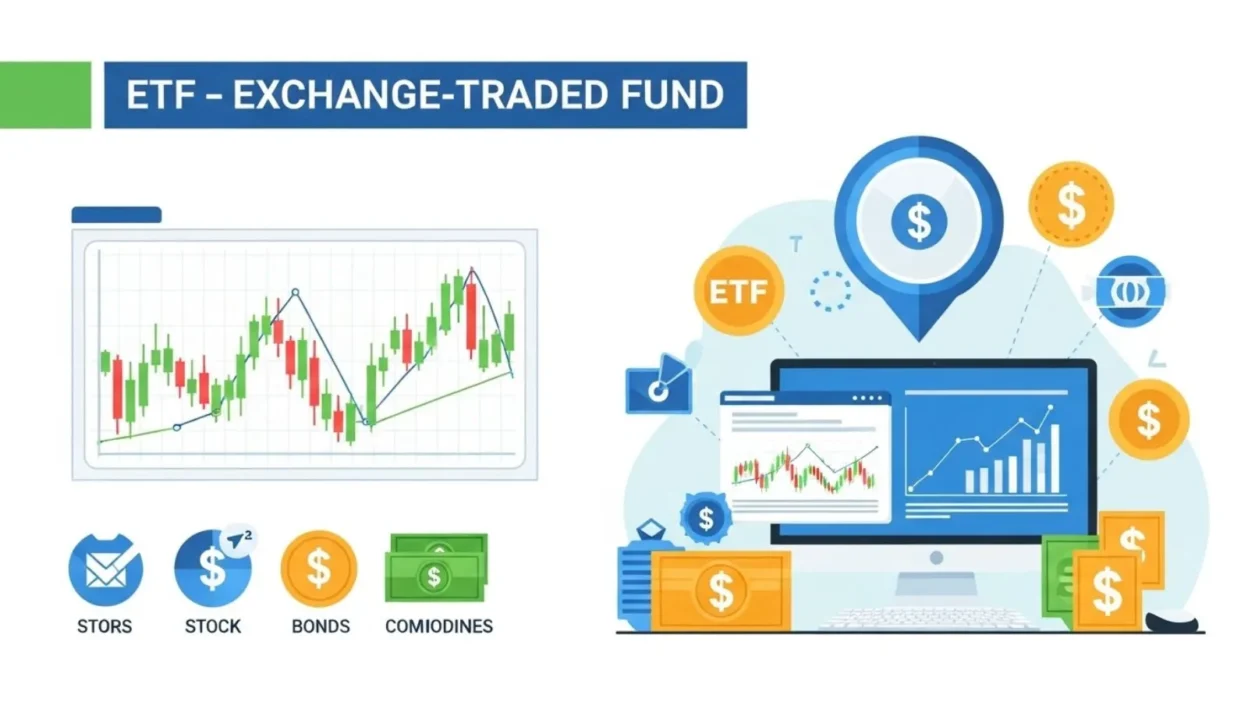
If you’ve ever explored investing, you’ve probably come across the term ETF, but what does it actually stand for? ETF is short for Exchange Traded Fund, a type of investment fund that trades on stock exchanges, much like individual stocks.
Unlike traditional mutual funds, ETFs allow investors to buy and sell shares throughout the trading day, offering flexibility, liquidity, and often lower fees.
They typically hold a diverse portfolio of assets, such as stocks, bonds, or commodities, making them a popular choice for beginners and experienced investors alike.
Understanding what an ETF is and how it works can help you make smarter investment decisions and diversify your portfolio efficiently.
In this article, we’ll explore everything you need to know about ETFs, from their definition and types to their benefits, risks, and how to get started with ETF investing.
Understanding ETFs: Exchange Traded Funds Explained
An ETF, or Exchange-Traded Fund, is a type of investment fund that combines the features of stocks and mutual funds. Essentially, an ETF holds a basket of assets—such as stocks, bonds, or commodities—and divides ownership into shares that investors can buy and sell on stock exchanges. This structure allows ETFs to offer diversification, as a single share represents exposure to multiple assets, reducing the risk of investing in just one company or sector.
Unlike mutual funds, which are priced at the end of the trading day, ETFs trade throughout the day like stocks, allowing investors to react to market movements instantly. Their prices fluctuate based on supply and demand as well as the net asset value (NAV) of the underlying holdings. Some ETFs track major stock indexes like the S&P 500, while others focus on specific sectors, themes, or even commodities such as gold or oil.
ETFs can be actively managed, where fund managers make investment decisions, or passively managed, aiming to replicate the performance of a specific index. Many investors favor ETFs because of their cost efficiency, transparency, and flexibility, making them suitable for both beginners and seasoned traders. Understanding these basics is the first step toward making informed investment decisions and building a balanced portfolio using ETFs.
How ETFs Work: The Basics of Trading and Investing
ETFs operate similarly to stocks but represent a diverse collection of assets, giving investors exposure to multiple securities in a single investment. When you buy a share of an ETF, you essentially own a small portion of all the underlying assets it holds. This feature provides instant diversification, which can reduce risk compared to investing in individual stocks.
One of the main advantages of ETFs is their trading flexibility. Unlike mutual funds, which are priced only once per day, ETFs are traded on stock exchanges throughout the trading day. This means investors can buy or sell shares at any time the market is open, using market orders, limit orders, or stop orders. The price of an ETF share generally tracks the Net Asset Value (NAV) of its underlying assets, though slight variations, called premium or discount, can occur due to market demand.
ETFs may also pay dividends or interest from the underlying investments. For example, a stock ETF may distribute dividends from the companies it holds, while a bond ETF passes along interest income. Investors can choose to reinvest these payouts or take them as income.
Additionally, ETFs can be actively or passively managed. Passive ETFs track a specific index, such as the S&P 500, while active ETFs are managed by professionals aiming to outperform the market. Understanding these mechanics is essential for making informed investment decisions and leveraging ETFs effectively in a portfolio.
Types of ETFs You Should Know About
1. Stock ETFs: These ETFs invest in a collection of stocks, often tracking a stock index like the S&P 500 or the Nasdaq 100. They allow investors to gain broad exposure to the stock market without buying individual shares.
2. Bond ETFs: These ETFs focus on bonds, including government, corporate, or municipal bonds. Bond ETFs provide a way to earn interest income and add stability to a portfolio, making them ideal for more conservative investors.
3. Commodity ETFs: Commodity ETFs invest in physical commodities such as gold, silver, oil, or agricultural products. They are useful for hedging against inflation and diversifying beyond stocks and bonds.
4. Sector and Industry ETFs: These ETFs focus on a specific sector or industry, like technology, healthcare, or energy. They allow investors to target areas they believe will perform well in the market.
5. Thematic ETFs: Thematic ETFs focus on trends or long-term themes such as clean energy, artificial intelligence, or blockchain technology. They can offer higher growth potential but often come with increased risk.
6. Inverse and Leveraged ETFs: Designed for advanced traders, these ETFs aim to amplify returns or profit from market declines. They are highly risky and not recommended for beginners.
By understanding the different types of ETFs, investors can choose funds that match their financial goals, risk tolerance, and investment strategy, whether seeking growth, income, or diversification.
Benefits of Investing in ETFs
Investing in ETFs offers a range of advantages that make them popular among both beginner and experienced investors. One of the biggest benefits is diversification. Because ETFs hold a basket of assets—stocks, bonds, or commodities—investors gain exposure to multiple securities in a single purchase. This reduces the risk of relying on just one investment.
Another advantage is liquidity. ETFs trade on stock exchanges throughout the trading day, just like individual stocks. Investors can buy or sell shares at market prices whenever the market is open, providing flexibility and the ability to react to market changes instantly.
Cost efficiency is also a major factor. ETFs typically have lower expense ratios than mutual funds because many are passively managed, tracking an index rather than requiring active management. This can save investors significant fees over time.
ETFs are also transparent, as most funds disclose their holdings daily, so investors know exactly what assets they own. Additionally, ETFs provide flexibility for different investment strategies. Some investors use them for long-term growth, others for income through dividend-paying ETFs, or even for hedging purposes using inverse or leveraged ETFs.
Finally, ETFs can suit both beginners and seasoned investors. Beginners benefit from diversification and simplicity, while experienced traders can use ETFs for tactical strategies and sector exposure. Overall, the combination of diversification, liquidity, low costs, and transparency makes ETFs a versatile and attractive investment option.
Risks and Considerations Before Investing
While ETFs offer numerous advantages, it’s important to understand the risks involved before investing. Like all investments, ETFs are subject to market risk, meaning the value of your investment can rise or fall based on overall market performance. Even diversified ETFs cannot completely eliminate losses during market downturns.
Another factor to consider is tracking error. ETFs are designed to follow an index or benchmark, but sometimes their performance may slightly differ due to management fees, operational costs, or market fluctuations. This small discrepancy can affect returns over time.
Liquidity risk is another consideration, especially with smaller or niche ETFs. Some ETFs may not trade frequently, making it harder to buy or sell shares without affecting the price. Investors should check trading volume before purchasing.
Expense ratios and fees can also impact returns. While ETFs are generally low-cost, actively managed or specialized ETFs may charge higher fees, which can eat into long-term gains.
Finally, specialized ETFs such as leveraged or inverse funds carry additional risks. These are designed for short-term trading strategies and can amplify losses as well as gains. They are not suitable for long-term investors without experience.
Before investing, it’s essential to assess your financial goals, risk tolerance, and investment timeline. Researching the ETF’s holdings, performance history, and fees will help you make informed decisions. Understanding these risks ensures that ETFs become a strategic tool for building a diversified and balanced investment portfolio, rather than a source of unexpected losses.
ETF vs Mutual Fund: Which One Is Right for You?
Many investors wonder whether they should choose an ETF or a mutual fund. While both are investment funds that pool money from multiple investors, there are key differences that can affect your investment strategy.
One of the main differences is how they are traded. ETFs are bought and sold on stock exchanges throughout the trading day, just like individual stocks. Their prices fluctuate constantly based on market supply and demand. In contrast, mutual funds are priced only once per day, at the end of trading, regardless of market movements. This makes ETFs more flexible for investors who want real-time trading opportunities.
Costs and fees also differ. ETFs generally have lower expense ratios because many are passively managed, tracking an index rather than being actively managed by a professional fund manager. Mutual funds often carry higher fees, especially actively managed ones, which can reduce overall returns over time.
Another consideration is tax efficiency. ETFs are generally more tax-efficient due to their unique structure, which allows investors to buy and sell shares without triggering as many capital gains taxes. Mutual funds may generate taxable events when the fund manager buys or sells assets within the fund.
However, mutual funds can be advantageous for automatic investments and long-term growth, as many offer features like automatic dividend reinvestment and systematic contributions.
Ultimately, choosing between an ETF and a mutual fund depends on your investment goals, trading style, and risk tolerance. For investors seeking flexibility, low costs, and tax efficiency, ETFs may be the better choice. For those prioritizing long-term, hands-off investing, mutual funds may still make sense.
How to Buy an ETF: A Step by Step Guide
1. Open a Brokerage Account:
To trade ETFs, you need a brokerage account. Choose a reputable platform that offers low fees, user-friendly tools, and access to a wide range of ETFs. Many online brokers also provide educational resources to help beginners.
2. Research ETFs:
Before investing, research the ETFs you’re interested in. Look at the fund’s objective, holdings, expense ratio, and historical performance. Consider whether you want a broad market ETF, a sector-focused ETF, or a thematic ETF.
3. Understand the Costs:
Check the expense ratio and any additional fees, such as trading commissions or account maintenance costs. While ETFs are generally low-cost, fees can impact long-term returns.
4. Place Your Order:
ETFs trade like stocks, so you can place market orders to buy at the current price or limit orders to buy at a specific price. You can also sell your shares at any time during market hours.
5. Monitor Your Investment:
After purchasing, regularly review your ETF’s performance and holdings. Keep track of dividends or interest payouts and consider reinvesting them to maximize growth.
6. Diversify Your Portfolio:
Even within ETFs, it’s wise to diversify across different asset classes, sectors, and geographies. This helps reduce risk and create a balanced investment strategy.
Popular ETFs to Consider in 2026
1. S&P 500 ETFs:
ETFs that track the S&P 500, such as the SPDR S&P 500 ETF (SPY), are among the most widely held funds. They offer exposure to the 500 largest U.S. companies, providing broad market diversification and a balance of growth and stability.
2. Nasdaq 100 ETFs:
ETFs like the Invesco QQQ track the Nasdaq 100 Index, focusing on technology and growth-oriented companies. These are ideal for investors seeking higher growth potential, though they can be more volatile.
3. Total Market ETFs:
Funds such as the Vanguard Total Stock Market ETF (VTI) offer exposure to the entire U.S. stock market, including large-, mid-, and small-cap companies. They are excellent for long-term, buy-and-hold strategies.
4. Bond ETFs:
Bond ETFs, like the iShares Core U.S. Aggregate Bond ETF (AGG), provide exposure to government and corporate bonds, offering stability and income for conservative investors.
5. Thematic ETFs:
Thematic ETFs focus on trends like artificial intelligence, clean energy, and blockchain technology. While riskier, they provide opportunities for investors looking to capitalize on emerging sectors.
6. International ETFs:
International ETFs, such as Vanguard FTSE All-World ex-US ETF (VEU), allow investors to diversify globally, gaining exposure to markets outside the U.S.
When selecting ETFs, consider your investment goals, risk tolerance, and time horizon. Combining these popular ETFs can help you create a balanced, diversified portfolio suitable for 2026 and beyond.
FAQs About ETFs
Investors often have many questions when learning about ETFs. Here are some of the most common questions and answers to help you understand them better:
1. What is the minimum investment for an ETF?
Unlike mutual funds, ETFs do not have a required minimum investment. You can buy as little as one share, making them accessible to beginners.
2. Are ETFs safe for beginners?
ETFs can be safe for beginners when chosen wisely. They offer diversification and usually lower costs than mutual funds. However, like all investments, they are subject to market risks.
3. Can I lose money in an ETF?
Yes, the value of an ETF can go up or down depending on market performance. Diversification can help reduce risk, but it does not eliminate the possibility of losses.
4. How often do ETFs pay dividends?
Many ETFs pay dividends or interest from their underlying assets, typically quarterly or annually. Investors can choose to reinvest these payments or receive them as cash.
5. Can I hold ETFs long-term?
Absolutely. ETFs are suitable for both short-term trading and long-term investing. Passive ETFs that track broad indexes are particularly effective for long-term growth.
6. How do ETFs differ from mutual funds?
ETFs trade like stocks on an exchange and are generally more tax-efficient and lower-cost. Mutual funds are priced once daily and may have higher fees.
7. What types of ETFs are best for beginners?
Beginner-friendly ETFs include broad market ETFs, S&P 500 ETFs, and total market ETFs, as they provide diversification and simplicity.
Conclusion:
ETFs, or Exchange Traded Funds, are a versatile and accessible investment option for both beginners and experienced investors.
They combine the diversification of mutual funds with the flexibility of stocks, allowing you to gain exposure to a wide range of assets stocks, bonds, commodities, and even international markets through a single investment.
The benefits of ETFs include low costs, transparency, and trading flexibility, making them an efficient tool for building a balanced portfolio. However, it’s important to be aware of market risks, tracking errors, and liquidity concerns, especially with specialized or leveraged ETFs.
By understanding how ETFs work, the types available, and how they fit into your investment strategy, you can use them to achieve your financial goals effectively.
If your focus is growth, income, or diversification, ETFs offer a smart and practical way to invest.
With careful selection and ongoing monitoring, they can play a key role in building a long term, diversified, and resilient portfolio.