Every day, we encounter the abbreviation PM, whether in texts, emails, social media, or work communications.
But what does it really mean? Depending on the context, PM can refer to time, a private message, or even a professional title like Project Manager or Prime Minister.
Misunderstanding it can lead to confusion imagine missing a 3 PM meeting because you thought it was AM, or replying publicly when the message was meant to be private.
This guide breaks down all the possible meanings of PM, helping you understand its use in everyday life, online interactions, and professional settings.
By the end of this article, you’ll confidently interpret PM wherever you see it, whether it’s on your phone, at work, or in the news.
Knowing the correct meaning ensures you communicate clearly and avoid awkward misunderstandings.
PM as Time
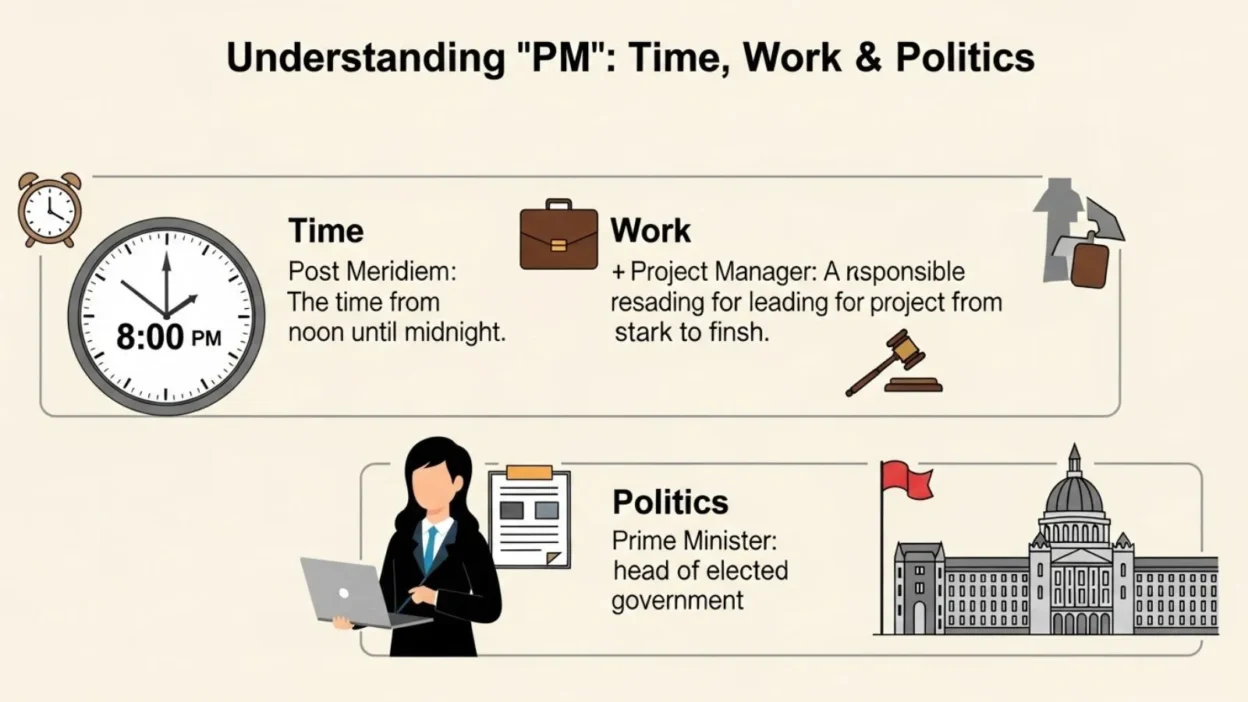
One of the most common uses of PM is in telling time. PM stands for post meridiem, a Latin term meaning “after midday.” It is part of the 12-hour clock system, used to differentiate the hours after noon from those before noon, which are labeled AM (ante meridiem, “before midday”). For example, 3 PM refers to three hours after noon, or 15:00 in the 24-hour clock format.
Understanding PM is essential for scheduling, appointments, and daily activities. Confusing AM and PM can lead to missed meetings, late arrivals, or even sending messages at the wrong time. Most digital devices, from smartphones to smartwatches, display time in either 12-hour or 24-hour formats, making it easier to recognize PM hours.
In everyday life, PM is used to indicate the second half of the day—from 12:00 noon to 11:59 at night. Whether planning a lunch meeting at 1 PM, catching a movie at 7 PM, or setting a reminder for 10 PM, knowing how to read PM correctly ensures your daily schedule runs smoothly.
Interestingly, the 12-hour system has been in use for centuries, dating back to ancient Egypt. While many countries now use the 24-hour clock for official purposes, PM remains widely used in casual and informal settings.
By mastering the concept of PM, you can confidently manage your time, avoid confusion, and communicate clearly about schedules.
PM in Messaging & Social Media
Beyond time, PM is widely used in online communication to mean “Private Message.” On social media platforms, forums, and messaging apps, a PM allows users to communicate privately, away from public posts or comments. For example, on Facebook or Twitter, sending someone a PM ensures that only the sender and recipient can read the message. This makes PMs ideal for sharing sensitive information, asking personal questions, or discussing topics that aren’t meant for a wider audience.
The etiquette of PMs is slightly different from public communication. Messages should be clear, concise, and respectful. Since PMs are private, it’s easy to unintentionally share personal opinions or sensitive content, so careful wording is important. On many platforms, PMs are also referred to as DMs (Direct Messages), and while the terms are similar, some communities distinguish them based on platform rules or features.
Using PMs effectively requires understanding context. A casual PM to a friend may be informal and humorous, while a PM to a professional contact should maintain a polite and professional tone. Misinterpreting the meaning of PM can lead to miscommunication, like responding publicly to a message intended to be private.
Overall, PMs provide a convenient way to communicate directly, maintain privacy, and build connections online. Recognizing when PM is used in this sense ensures your digital conversations are handled appropriately and effectively.
PM as Professional or Official Titles
In professional and official contexts, PM often stands for a title rather than time or messaging. The most common interpretations are Project Manager and Prime Minister, and understanding which one applies depends entirely on the situation.
A Project Manager (PM) is a key role in business, technology, and corporate environments. Project Managers are responsible for planning, executing, and overseeing projects to ensure they are completed on time and within budget. They coordinate teams, set milestones, manage resources, and communicate with stakeholders. When you see “PM” in emails, meeting invites, or organizational charts, it often refers to this role, particularly in workplaces, tech companies, or project-based teams.
In political contexts, PM refers to the Prime Minister, the head of the government in many countries. News articles, international reports, and political discussions frequently use PM as shorthand for this title. For example, “The PM addressed the nation today” clearly points to a political leader rather than a time or message.
There are also other professional or technical uses of PM. In engineering or industrial fields, PM can stand for Preventive Maintenance, indicating scheduled upkeep of machinery or equipment. In corporate HR, it may refer to Performance Management, relating to employee evaluations and goal tracking.
The key takeaway is that context determines the correct interpretation. Recognizing whether PM refers to a job title, political leader, or technical term ensures clarity in communication and avoids confusion, especially in professional or formal settings.
Other Contextual Meanings of PM
While PM is commonly understood as a time indicator, private message, or professional title, it can also have several other meanings depending on the field or context. Recognizing these less common interpretations can help avoid misunderstandings.
In medical and legal contexts, PM can stand for Post Mortem, which refers to an examination of a body after death. Post mortem reports are often abbreviated as PM in official documents, news reports, or case studies. Understanding this usage is crucial when reading medical or legal literature to avoid confusion with more casual meanings.
In business and engineering, PM is frequently used to indicate Preventive Maintenance, which involves regular checks and upkeep of machinery or systems to prevent breakdowns. Similarly, in corporate settings, PM may refer to Performance Management, a process used by HR departments to monitor and improve employee productivity and achievements.
In online slang or informal texting, PM can occasionally have unique interpretations based on subcultures or niche communities, though these are less common. For instance, some users might abbreviate personal phrases in casual chat, but the meaning usually depends on context.
The key to understanding these alternative uses of PM is to pay attention to context clues. Look at the industry, platform, or surrounding text to determine the correct meaning. Misreading PM in these cases can lead to misunderstandings, especially in professional, legal, or technical communications.
By being aware of these additional meanings, you can confidently interpret PM wherever you encounter it, whether online, at work, or in specialized documents.
How to Determine the Correct Meaning of PM
Because PM has multiple meanings, understanding its intended use requires careful attention to context. Whether you encounter PM in a text, email, social media platform, or professional document, there are strategies to help you identify the correct interpretation.
The first step is to consider the setting. If PM appears in a discussion about schedules, appointments, or daily routines, it almost certainly refers to time—post meridiem, meaning the hours after noon. If it shows up on social media, forums, or chat apps, it is likely shorthand for Private Message, indicating a one-on-one conversation.
Next, look for contextual clues in the surrounding text. For instance, if PM appears alongside corporate terms, project updates, or team tasks, it may indicate a Project Manager. Similarly, mentions of governments, countries, or political discussions may signal Prime Minister. In technical or industrial documents, PM could refer to Preventive Maintenance, while in legal or medical reports, it might mean Post Mortem.
When in doubt, ask for clarification. Politely confirming the meaning is better than assuming incorrectly, especially in professional or sensitive contexts. Additionally, consistent use of abbreviations in written communication—like defining PM at the first instance—can prevent confusion.
By using context clues, considering the platform, and asking for clarification when necessary, you can accurately interpret PM in any situation. Understanding its meaning ensures effective communication, avoids misunderstandings, and demonstrates attention to detail in both personal and professional settings.
FAQs About PM
1. What is the difference between PM and AM?
PM and AM are abbreviations used in the 12-hour clock system. AM stands for ante meridiem (“before midday”), while PM stands for post meridiem (“after midday”). AM covers 12:00 midnight to 11:59 in the morning, and PM covers 12:00 noon to 11:59 at night. Knowing the difference helps prevent scheduling errors and confusion.
2. Can PM mean something different on social media?
Yes! On platforms like Facebook, Twitter, and forums, PM usually stands for Private Message. This is a direct message between users, visible only to the sender and recipient. It differs from public posts or comments, making PMs ideal for private conversations.
3. How do I know if PM refers to Project Manager or Prime Minister?
The meaning depends on context. In workplaces, tech companies, and project-related documents, PM usually refers to Project Manager. In political discussions or news, PM typically refers to the Prime Minister. Pay attention to surrounding words to determine the correct usage.
4. Are PMs always formal in messaging?
Not necessarily. PMs can be formal or informal depending on the audience. A PM to a friend may be casual, while a PM to a professional contact should be polite and clear. Always match the tone to the situation.
5. Are there other meanings of PM I should know?
Yes, in specialized fields, PM can mean Preventive Maintenance, Performance Management, or Post Mortem. Always rely on context to understand these niche uses.
Conclusion:
The abbreviation PM is one of those versatile terms that appears in everyday life, digital communication, and professional environments.
Its meaning can vary widely depending on the context, ranging from time notation to private messages, or even formal titles such as Project Manager and Prime Minister.
Understanding the correct meaning of PM is essential to communicate clearly, avoid misunderstandings, and interpret messages accurately.
When it comes to time, PM simply indicates the hours after noon, helping people schedule appointments, meetings, and daily activities.
In the digital world, PM commonly refers to a Private Message, a secure and direct way to communicate online without broadcasting information publicly.
In professional and official contexts, PM can refer to a Project Manager, who oversees projects and coordinates teams, or a Prime Minister, the head of government.
There are also other specialized uses, such as Preventive Maintenance, Performance Management, and Post Mortem, which highlight the importance of context in interpreting PM correctly.
The key takeaway is that context is everything. By paying attention to surrounding words, platform, or industry, you can confidently determine the intended meaning of PM. When unsure, asking for clarification is always better than making assumptions.
Ultimately, mastering the different uses of PM empowers you to communicate effectively in everyday life, online conversations, and professional settings.
If scheduling a meeting at 3 PM, sending a private message, or discussing a PM at work, knowing the correct meaning ensures clarity and prevents confusion.