Have you ever heard someone say, Isn’t it ironic? after something unexpected happens and wondered what they really mean? Irony is one of those words that people often use incorrectly, yet it plays a powerful role in language, literature, and everyday life.
At its core, being ironic means expressing or experiencing a situation where the outcome is opposite to what is expected or saying something that conveys the opposite of your literal meaning.
From witty remarks in conversations to dramatic twists in movies and novels, irony adds humor, surprise, and depth to communication.
Understanding what ironic truly means helps you recognize subtle humor, appreciate literature, and avoid common misuses.
In this article, we’ll explore the meaning of ironic, its different types, real life and literary examples, common mistakes, and practical tips for using it correctly. By the end, you’ll be able to spot and use irony with confidence.
What is the Meaning of Ironic?
The word “ironic” often confuses people because it is frequently misused in everyday conversation. At its core, being ironic involves a contrast between expectation and reality—something happens that is the opposite of what you would logically anticipate. In simpler terms, irony occurs when there’s a twist, contradiction, or unexpected outcome that challenges what seems normal or predictable.
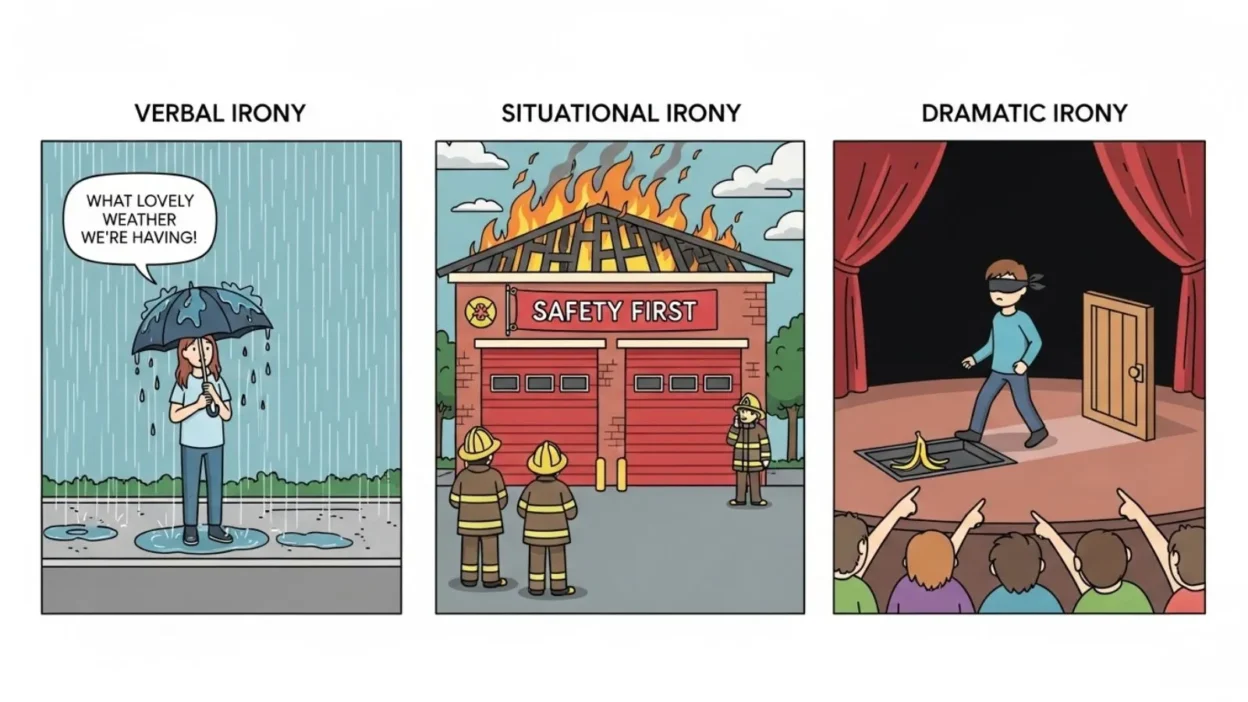
For example, imagine a fire station burning down. You wouldn’t expect a place dedicated to preventing fires to catch fire itself—this is a classic case of situational irony. Many people mistakenly label any unfortunate or coincidental event as ironic, but true irony always involves a meaningful contrast, not just bad luck.
Irony is also different from sarcasm, though the two are often confused. Sarcasm is usually verbal and intended to mock or ridicule, while irony can exist in situations, speech, or literature without any personal attack. The term can also be applied in literary contexts, where authors use irony to create tension, humor, or deeper meaning.
Understanding the true meaning of ironic is important because it allows you to recognize subtle humor, appreciate storytelling, and communicate more effectively. By spotting the contrast between expectation and reality, you can identify whether a situation, remark, or event is genuinely ironic or simply coincidental.
Types of Irony
Irony comes in several forms, each adding a unique twist to language, storytelling, and everyday situations. Understanding the types of irony helps you recognize and use them correctly.
1. Verbal Irony
Verbal irony occurs when someone says the opposite of what they actually mean. For example, if it’s pouring rain and someone comments, “What a lovely day,” they are using verbal irony. This type of irony is often subtle and depends on tone of voice or context to convey the true meaning.
2. Situational Irony
Situational irony happens when there’s a contrast between what is expected and what actually occurs. A classic example is a traffic cop receiving a speeding ticket. The irony lies in the fact that someone responsible for enforcing rules ends up breaking them. Situational irony is common in real life, movies, and literature, often adding humor or surprise.
3. Dramatic Irony
Dramatic irony is primarily used in storytelling. It occurs when the audience knows something that the characters do not. For instance, in horror movies, viewers often know the villain is hiding nearby, creating suspense as the character unknowingly approaches danger. Dramatic irony builds tension, humor, or emotional impact in books, films, and plays.
Other Forms
Less common forms include cosmic irony, where fate seems to play a cruel trick, and Socratic irony, where someone pretends ignorance to reveal another person’s flaw.
Recognizing the type of irony in a situation or story helps readers and viewers better understand humor, meaning, and subtle messages, making communication richer and more engaging.
Examples of Ironic Situations
Irony isn’t just a literary device; it appears all around us in everyday life, pop culture, and literature. Recognizing ironic situations can make humor, storytelling, and even casual conversation more meaningful.
Everyday Life Examples
Situational irony often occurs in daily life. For instance, imagine a pilot who is afraid of heights or a fitness trainer who struggles with their own health. These scenarios are ironic because the outcome or circumstance contrasts sharply with expectations. Another example is a fire alarm going off during a fire drill that no one takes seriously—the very thing designed to prevent panic causes confusion instead.
Pop Culture Examples
Movies, TV shows, and music frequently use irony to engage audiences. In romantic comedies, a character might be desperately seeking love while the perfect partner is right under their nose, creating humorous situational irony. On social media, memes often highlight ironic twists, such as someone proudly posting about safety while doing something risky.
Literary Examples
Authors often use irony to add depth or humor. Shakespeare’s Romeo and Juliet contains dramatic irony: the audience knows Juliet is alive when Romeo believes she is dead, heightening the tragedy. Similarly, Oscar Wilde’s works often feature witty verbal irony, where characters say one thing but mean another, exposing social hypocrisy.
Common Mistakes People Make With Ironic
Despite how often people use the word, “ironic” is frequently misapplied, which can lead to confusion or misunderstanding. Understanding common mistakes helps ensure correct usage.
1. Confusing Irony with Coincidence
One of the most common errors is calling any surprising or unfortunate event ironic. For example, if you meet a friend at the grocery store by chance, it’s a coincidence, not irony. True irony requires a contrast between expectation and reality, not just a random occurrence.
2. Confusing Irony with Sarcasm
Irony and sarcasm are often mistaken for each other, but they differ. Sarcasm is usually verbal and meant to mock or criticize, while irony may be situational, verbal, or dramatic, without any intent to ridicule. Saying, “Nice job!” when someone trips is sarcastic, not necessarily ironic.
3. Mislabeling Bad Luck as Irony
Not every unfortunate event is ironic. Losing an umbrella in the rain isn’t ironic—it’s just unlucky. True irony often contains a twist or contradiction that adds meaning, humor, or insight.
4. Overusing the Term
Some people overuse “ironic” to describe any surprising situation. Overuse diminishes the word’s impact and can confuse listeners or readers.
Tips to Avoid Mistakes
- Ask yourself: Is there a meaningful contrast between expectation and reality?
- Consider context: is the irony verbal, situational, or dramatic?
- Avoid using “ironic” for simple coincidences or misfortune.
By avoiding these common pitfalls, you can use “ironic” accurately, making your speech and writing clearer, more precise, and more engaging.
How to Use IronicCorrectly
Using the word “ironic” correctly can make your writing and speech sharper and more precise. The key is understanding that irony always involves a contrast between what is expected and what actually happens.
1. Situational Examples
Situational irony occurs when reality defies expectation. For instance, a police station getting robbed is ironic because you would expect a place that enforces the law to be secure. Another example is a dietitian accidentally eating fast food while on break. When using “ironic” in these contexts, highlight the unexpected contrast to make the meaning clear.
2. Verbal Examples
Verbal irony occurs when someone says the opposite of what they mean, often with a humorous or sarcastic tone. For example, if it’s freezing outside and someone says, “Lovely weather today,” it’s ironic. To use verbal irony effectively, rely on context, tone, or body language so the listener understands the intended meaning.
3. Literary or Dramatic Examples
In literature or storytelling, irony can convey deeper meaning or emotion. For instance, in a novel, a character might boast about their invincibility, only to face an unexpected defeat. When using “ironic” in writing, emphasize the gap between expectation and outcome.
Tips for Correct Usage
- Ensure a meaningful contrast exists.
- Avoid labeling simple bad luck or coincidences as ironic.
- Consider the type: verbal, situational, or dramatic.
- Use examples or context to clarify the irony.
By following these guidelines, you can use “ironic” accurately, making your communication more effective, witty, and engaging.
Why Understanding Irony Matters
Understanding irony is more than just knowing a definition—it can enhance communication, improve critical thinking, and enrich your appreciation of literature and humor. Irony allows people to recognize subtle contrasts between expectation and reality, which makes language more expressive and nuanced.
1. Enhances Communication
When you understand irony, you can use it effectively in conversation and writing. Verbal irony can add humor or emphasis, making your speech more engaging. For example, saying “Great job!” after a minor mistake can lighten the mood while conveying the opposite meaning in a playful way. Recognizing irony in others’ speech also helps avoid misunderstandings, as you can distinguish between sarcasm, humor, and literal statements.
2. Improves Critical Thinking
Irony often requires analysis to understand the gap between expectation and reality. Spotting irony in situations or texts encourages you to think more deeply about context, motives, and consequences, sharpening your observation and reasoning skills.
3. Enriches Literary Appreciation
Many authors, playwrights, and filmmakers use irony to create humor, suspense, or emotional depth. Understanding dramatic or situational irony helps readers and viewers fully appreciate the layers of meaning in stories, from Shakespearean plays to modern novels and films.
4. Adds Humor and Perspective
Irony can highlight life’s unexpected twists, providing humor or insight. Recognizing ironic situations encourages a more flexible, observant approach to daily experiences, allowing you to see contrasts and contradictions that others might overlook.
Quick Tips to Identify Irony
Irony can be subtle, so knowing how to spot it in conversation, writing, or everyday situations is essential. Here are some practical tips to help you identify irony accurately.
1. Look for a Contrast Between Expectation and Reality
Irony always involves a meaningful contradiction. Ask yourself: Does what happened or was said defy what I would logically expect?
For Example:
A lifeguard needing to be rescued is ironic because it contrasts with the expectation of their role.
2. Consider the Context
Context is key to understanding irony. In verbal irony, tone of voice, facial expressions, or body language often signal the intended meaning. In writing, surrounding events or descriptions can reveal situational or dramatic irony.
3. Identify the Type of Irony
- Verbal irony: Saying the opposite of what you mean.
- Situational irony: An unexpected outcome occurs.
- Dramatic irony: The audience knows more than the characters. Recognizing the type helps you interpret the situation correctly.
4. Look for Subtle Humor or Contradiction
Irony often creates humor or highlights contradictions. If a statement or event seems humorous because it contrasts with expectations, it may be ironic.
5. Avoid Mistaking Coincidence or Bad Luck for Irony
Not every surprising or unfortunate situation is ironic. True irony requires a meaningful twist or contradiction, not just a random event.
Frequently Asked Questions About Irony
1. Is “ironic” the same as coincidence?
No. Many people mistakenly call any surprising event ironic, but true irony involves a meaningful contrast between expectation and reality. Coincidence is simply a chance occurrence without that underlying contrast. For example, meeting an old friend at a grocery store is coincidental, not ironic.
2. Can situations be both ironic and funny?
Yes. Irony often creates humor because it highlights an unexpected or contradictory outcome. A traffic cop getting a speeding ticket is ironic and can also be funny because of the contrast between expectations and reality.
3. How do you use “ironic” in a sentence?
Use “ironic” when there is a clear contrast between what is expected and what actually happens. Examples:
- It was ironic that the fire station burned down.
- Her saying “I love long meetings” during a three-hour seminar was clearly ironic.
4. What is the difference between irony and sarcasm?
Sarcasm is usually verbal and intended to mock or ridicule, whereas irony can be situational, verbal, or dramatic, without necessarily mocking anyone. Sarcasm relies on tone, while irony relies on contrast.
5. How can I spot irony in everyday life?
Look for situations where reality defies expectation, or someone says the opposite of what they mean. Consider the context, tone, and type of irony—verbal, situational, or dramatic—to correctly identify it.
Conclusion:
Irony is a fascinating and versatile element of language, storytelling, and everyday life. At its core, being ironic means highlighting a contrast between expectation and reality, if through words, situations, or dramatic storytelling.
Understanding irony allows you to communicate more effectively, appreciate humor, and enjoy literature and media on a deeper level.
By recognizing the different types verbal, situational, and dramatic and avoiding common mistakes like confusing irony with coincidence or sarcasm, you can use the term accurately in conversation and writing.
Real life examples, pop culture references, and literary illustrations show how irony adds wit, surprise, and insight to ordinary events.
Next time you encounter a twist of fate, a clever remark, or a dramatic scene, take a moment to ask: Is this ironic? By doing so, you’ll sharpen your observation, enhance your appreciation of humor and storytelling, and confidently use ironic in the right context. Irony, when understood, becomes a tool for both insight and enjoyment.