Impeachment is a term that often makes headlines, especially during political controversies, but its meaning is not always clear to the general public.
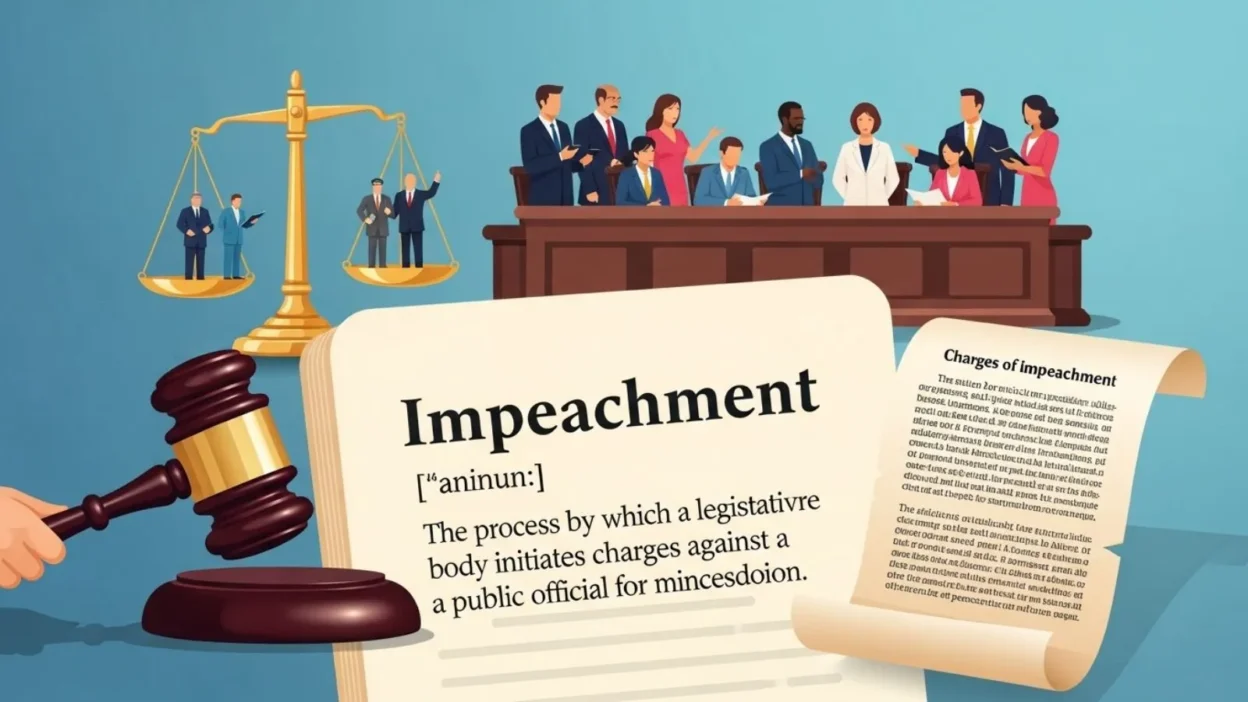
At its core, impeachment is a formal process used to accuse a public official of misconduct while in office.
It is not a punishment in itself, but rather a constitutional tool designed to hold leaders accountable and protect the integrity of government institutions.
If it involves a president, prime minister, or other high-ranking official, impeachment signals serious allegations such as abuse of power, corruption, or other forms of wrongdoing.
Understanding what impeachment means and how it works is crucial for citizens who want to stay informed about the actions of their government.
In this article, we will break down the definition, history, process, and real world examples of impeachment, helping you grasp why this mechanism is vital for maintaining a functioning and accountable democracy.
Definition of Impeachment
Impeachment is a formal and constitutional process by which a public official is accused of misconduct while holding office. It does not mean the official is automatically removed from their position; rather, it is the first step in determining whether removal or further legal consequences are necessary. The concept of impeachment exists to ensure that leaders, regardless of their rank, remain accountable for actions that could undermine public trust or the functioning of government.
In the United States, the Constitution outlines that federal officials, including the president, vice president, and other civil officers, can be impeached for “high crimes and misdemeanors.” While this phrase may sound vague, it generally covers serious abuses of power, corruption, bribery, or other forms of misconduct that threaten the rule of law. Importantly, impeachment is a political process rather than a criminal one. The legislature typically initiates it, investigates the allegations, and decides whether to formally charge the official. If impeached, the case may proceed to a trial in a separate body—such as the Senate in the U.S.—which then determines guilt and potential removal from office.
Beyond the U.S., impeachment exists in various forms around the world, often tailored to each country’s legal and political system. Despite differences, the central principle remains the same: impeachment serves as a safeguard, ensuring that no one is above the law and reinforcing the checks and balances that are fundamental to democratic governance.
Historical Background
The concept of impeachment has a long history, tracing back to medieval England, where Parliament held the authority to remove officials who abused their power or violated the law. It was designed as a way for governing bodies to maintain accountability and prevent leaders from acting above the law. This idea was later incorporated into the United States Constitution, ensuring that elected officials could be held responsible for serious misconduct.
In the U.S., impeachment has been a rare but significant tool. The first president to face impeachment was Andrew Johnson in 1868, following disagreements with Congress over Reconstruction policies after the Civil War. While Johnson was impeached, he was ultimately acquitted by the Senate and remained in office. Later, President Bill Clinton was impeached in 1998 on charges related to perjury and obstruction of justice, but like Johnson, he was not removed from office. More recently, President Donald Trump faced impeachment twice, highlighting how the process continues to play a role in modern politics.
Globally, other countries have also adopted impeachment or similar procedures to ensure accountability. For example, South Korea impeached President Park Geun-hye in 2016 for corruption, leading to her removal from office. These examples show that while the process and legal frameworks may differ, the principle remains consistent: impeachment is a critical mechanism for maintaining checks and balances, protecting democratic institutions, and ensuring that leaders are held accountable for actions that threaten the integrity of governance.
Impeachment Process Explained
The impeachment process is a formal procedure designed to hold public officials accountable for serious misconduct. While details can vary by country, the process generally follows a series of clear steps to ensure fairness and transparency. In the United States, for example, the process begins in the House of Representatives, where members investigate allegations against the official. This investigation may involve gathering evidence, conducting hearings, and interviewing witnesses to determine if there are grounds for impeachment.
If the House finds sufficient evidence, it can vote to impeach the official, formally charging them with wrongdoing. This vote is similar to an indictment in a criminal case but does not result in immediate removal from office. Once impeached, the case moves to the Senate for trial. The Senate acts as the judge, and in presidential cases, the Chief Justice of the Supreme Court presides over the proceedings. Senators review the evidence, hear arguments, and ultimately vote on whether to convict the official. A two-thirds majority is typically required for conviction.
If convicted, the official can be removed from office and may face additional legal consequences. However, if acquitted, they remain in their position. It’s important to note that impeachment is a political process, not a criminal trial. Its main purpose is to protect democratic institutions and enforce accountability. Despite its seriousness, impeachment is rare, reserved for the most egregious abuses of power, ensuring that government leaders are not above the law while preserving the stability of governance.
Grounds for Impeachment
Impeachment is reserved for serious misconduct, and not every mistake or unpopular decision qualifies an official for this process. The U.S. Constitution specifies that federal officials can be impeached for “high crimes and misdemeanors,” a phrase that has been interpreted over time to cover a range of serious abuses of power. Common grounds for impeachment include corruption, bribery, perjury, abuse of authority, obstruction of justice, and other actions that undermine the integrity of government.
Abuse of power is one of the most frequent reasons for impeachment. This occurs when an official uses their position to benefit themselves or others improperly, or to harm political opponents. Bribery and corruption, where officials accept money or favors in exchange for political decisions, are also clear grounds for impeachment. Additionally, obstruction of justice—interfering with investigations or manipulating legal processes—has historically been cited in impeachment cases.
It’s important to understand that impeachment is not limited to criminal activity. Even behavior that may not be illegal can be considered impeachable if it violates public trust or threatens the functioning of government. For example, lying under oath, neglecting constitutional duties, or undermining democratic processes can all justify impeachment. The key principle is accountability: impeachment ensures that officials who breach ethical, legal, or constitutional responsibilities can be formally held responsible. By defining these grounds, the process protects democracy and reinforces the idea that no one is above the law.
Famous Impeachment Cases
Throughout history, impeachment has been a rare but highly significant political event. In the United States, three presidents have faced formal impeachment proceedings, each offering important lessons about accountability and the limits of political power.
The first, President Andrew Johnson in 1868, was impeached primarily for violating the Tenure of Office Act by removing a cabinet member without Senate approval. Johnson’s impeachment highlighted the tensions between the executive branch and Congress during the Reconstruction era. Despite being impeached by the House of Representatives, he was acquitted by a single Senate vote and remained in office.
President Bill Clinton was impeached in 1998 on charges of perjury and obstruction of justice related to his personal conduct. The House approved two articles of impeachment, but the Senate acquitted him, allowing him to complete his second term. Clinton’s case illustrated that impeachment is a political process influenced by public opinion and partisan dynamics, not solely legal considerations.
More recently, President Donald Trump faced impeachment twice—first in 2019 over alleged abuse of power and obstruction of Congress, and again in 2021 related to incitement of violence. He was acquitted by the Senate both times, demonstrating how impeachment can be used even amid deeply polarized political contexts.
Outside the U.S., impeachment has also played a critical role in other countries. For example, South Korea’s President Park Geun-hye was impeached and removed from office in 2017 for corruption and abuse of power. These cases emphasize that impeachment, while complex and controversial, remains a vital tool for maintaining democratic accountability worldwide.
Political Implications
Impeachment is more than a legal procedure—it carries significant political consequences that can affect governance, public trust, and the stability of a country. Even the initiation of impeachment proceedings can dominate news cycles, influence public opinion, and impact the effectiveness of a government. Leaders facing impeachment often experience reduced political authority, as legislators, allies, and international partners may hesitate to cooperate amid uncertainty.
One major implication of impeachment is its effect on elections. Public perception of the process can shape voter behavior, sway midterm or presidential elections, and redefine party dynamics. For instance, debates over President Bill Clinton’s impeachment influenced the political climate in the late 1990s, while President Donald Trump’s impeachments intensified partisan divisions in the United States. In highly polarized environments, impeachment can also become a strategic tool used by opposition parties to challenge or weaken a sitting leader, rather than a strictly legal or ethical measure.
Impeachment can also affect policy-making. Officials under impeachment may struggle to advance legislative agendas, as political allies focus on defending the leader or distancing themselves from controversy. Conversely, successful impeachment reinforces the principle that leaders are accountable, potentially strengthening democratic institutions.
Globally, impeachment demonstrates that no public official is immune from scrutiny. While it can create temporary instability, it ultimately serves as a mechanism to uphold the rule of law and preserve trust in government. Understanding these political implications helps citizens appreciate why impeachment is a critical, though often contentious, component of democratic governance.
Legal and Constitutional Significance
Impeachment is a cornerstone of constitutional law, designed to maintain checks and balances within a democratic system. Its primary legal significance lies in ensuring that no public official, regardless of rank, is above the law. By providing a formal mechanism to hold leaders accountable for serious misconduct, impeachment reinforces the rule of law and protects the integrity of government institutions.
In the United States, the Constitution explicitly grants Congress the power to impeach and remove federal officials for “high crimes and misdemeanors.” This authority is an essential part of the system of checks and balances, preventing the executive branch from accumulating unchecked power. The House of Representatives initiates the impeachment process, acting as the investigative body, while the Senate conducts the trial and determines whether the official should be removed from office. This division of responsibilities ensures that impeachment is deliberate, balanced, and guided by both political and legal considerations.
Impeachment also has broader constitutional significance beyond individual cases. It sets a precedent for accountability, signaling that misconduct—whether in the form of corruption, abuse of power, or obstruction of justice—will not be tolerated. Furthermore, it reinforces citizens’ trust in democratic institutions by demonstrating that leaders are answerable to the people and to the law.
Internationally, many countries have adopted similar procedures in their constitutions, reflecting the universal principle that accountability and oversight are critical to governance. Overall, impeachment serves as a legal safeguard, ensuring that democracy functions fairly and that governmental authority is exercised responsibly.
Common Misconceptions
Despite being a widely discussed political process, impeachment is often misunderstood by the public. One of the most common misconceptions is that impeachment automatically means removal from office. In reality, impeachment is similar to an indictment in a criminal case: it is a formal accusation, not a verdict. An official can be impeached yet remain in office if the trial body, such as the Senate in the United States, does not reach the necessary threshold for conviction.
Another frequent misunderstanding is that impeachment is inherently a criminal process. While it may involve allegations of illegal behavior, impeachment is primarily a political and constitutional procedure. Its purpose is to protect the integrity of government institutions, rather than to prosecute in a court of law. Criminal prosecution may follow impeachment, but the two processes are separate.
People also sometimes confuse impeachment with mere unpopularity or political disagreement. An official cannot be impeached simply for making unpopular decisions or having differing political views. Impeachment is reserved for serious misconduct, including abuse of power, bribery, corruption, and obstruction of justice.
Finally, media coverage can create the illusion that impeachment is dramatic and immediate, when in fact it is often a lengthy and deliberate process. Misunderstanding these aspects can lead to confusion and misinformation among the public. By clarifying these misconceptions, citizens can better understand the true purpose and significance of impeachment as a safeguard of democracy and a mechanism for accountability.
How Citizens Can Stay Informed
Understanding impeachment is not only about knowing the legal process—it’s also about being an informed and engaged citizen. Following credible and reliable news sources is essential to avoid misinformation and sensationalized reporting. National newspapers, reputable news networks, and official government releases provide accurate updates on ongoing impeachment proceedings.
Citizens can also educate themselves by studying the constitution and legal frameworks that govern impeachment. Many governments publish official documents outlining the rules and procedures for impeachment, which can help readers distinguish between fact and political commentary. Learning about historical cases of impeachment, both domestic and international, provides valuable context for understanding current events.
Engaging in discussions with peers, attending civic forums, or participating in educational webinars can also deepen understanding. These platforms allow citizens to ask questions, explore different perspectives, and develop critical thinking about political processes. Social media, while useful for staying updated, should be approached carefully; following verified accounts and cross-checking information helps prevent the spread of rumors.
Finally, staying informed empowers citizens to participate meaningfully in democracy. It allows voters to make educated decisions, hold leaders accountable, and engage in conversations about governance and public trust. Impeachment is a reminder that government actions impact society, and understanding it equips individuals to assess political developments responsibly. Informed citizens are the backbone of a functioning democracy, and learning about impeachment is an important step toward active civic engagement.
Frequently Asked Questions (FAQs)
1. What does it mean when a president is impeached?
Impeachment means the president has been formally accused of serious misconduct. It is a political process and does not automatically remove them from office. Removal occurs only if the trial body, such as the Senate in the U.S., votes to convict.
2. Can a president be impeached twice?
Yes. A president can be impeached more than once during their term(s) if new grounds for impeachment arise. For example, President Donald Trump was impeached twice in U.S. history.
3. What are high crimes and misdemeanors?
This term refers to serious misconduct that violates public trust, including abuse of power, corruption, bribery, obstruction of justice, or other actions that threaten democratic governance.
4. Is impeachment a criminal trial?
No. Impeachment is a constitutional and political process. While it may involve allegations of illegal activity, it is separate from criminal prosecution, which may follow if laws were broken.
5. Does impeachment happen only in the U.S.?
No. Many countries, such as South Korea, Brazil, and others, have impeachment or similar procedures to hold high ranking officials accountable for misconduct.
Conclusion:
Impeachment is a vital mechanism in democratic governance, designed to hold public officials accountable for serious misconduct and protect the integrity of government institutions.
While it is often misunderstood as automatic removal from office or a criminal trial, impeachment is primarily a constitutional and political process.
It serves as a check on power, ensuring that leaders cannot act above the law or violate public trust without consequence.
Historical and contemporary cases from Andrew Johnson and Bill Clinton to Donald Trump and international examples demonstrate its significance and complexity.
Understanding impeachment empowers citizens to critically evaluate government actions, participate meaningfully in political discourse, and uphold democratic values.
By staying informed, engaging with credible sources, and learning about the process, individuals can better appreciate the role impeachment plays in maintaining accountability and stability within society.
Ultimately, impeachment is not just a political tool it is a safeguard that reinforces the principles of transparency, responsibility, and justice in governance.

The author behind RiddleBurst.com loves creating fun, clever, and unique riddles for all ages. Their goal is to challenge minds, bring smiles, and make learning through riddles both engaging and enjoyable.