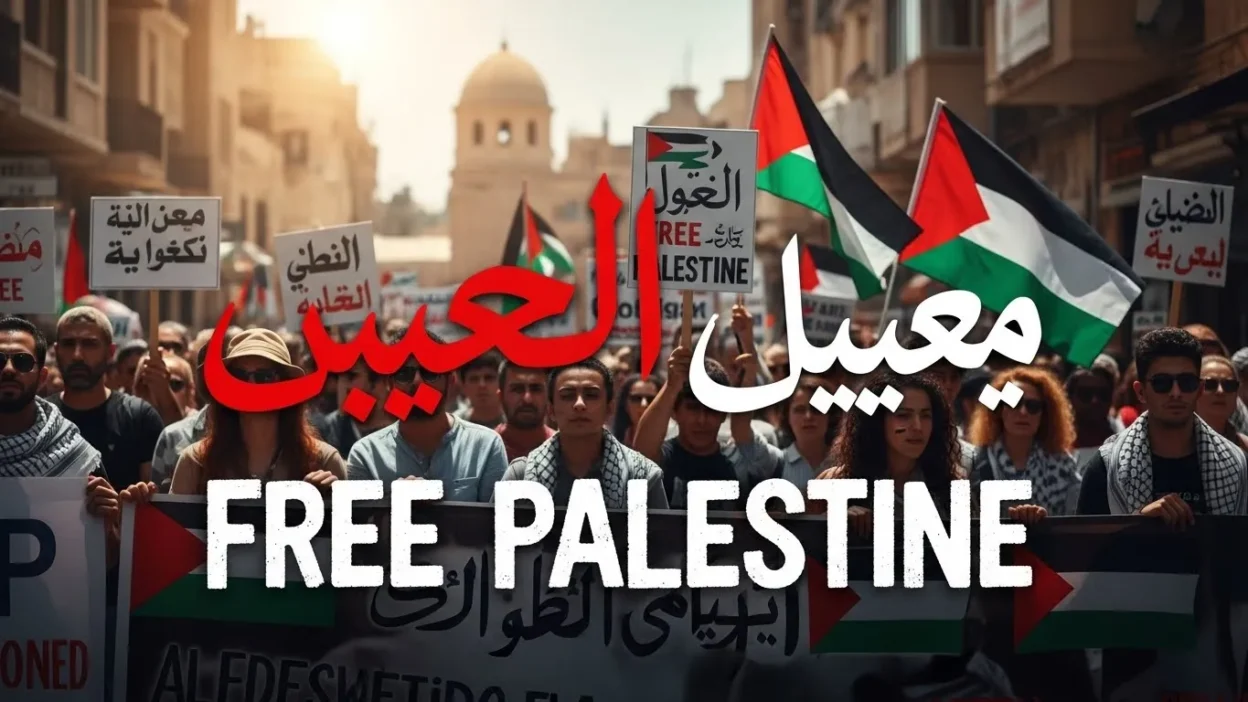
The phrase Free Palestine has become one of the most widely recognized slogans in global political and social activism.
But what does it actually mean? At its core, Free Palestine is a call for justice, human rights, and self-determination for the Palestinian people, who have faced decades of conflict, occupation, and displacement.
The phrase carries layers of historical, political, and humanitarian significance, reflecting the struggles and aspirations of millions.
For some, it represents a demand for political sovereignty and an end to Israeli occupation; for others, it symbolizes solidarity, advocacy, and raising awareness about ongoing humanitarian crises in Gaza and the West Bank.
Understanding the meaning of “Free Palestine” requires exploring its historical roots, the modern-day realities of the Israeli-Palestinian conflict, and the ways people worldwide have used the slogan to voice their support.
This article will break down these dimensions and help you grasp the full context behind the phrase.
What Free Palestine Means
The phrase “Free Palestine” is more than just a slogan—it carries deep political, historical, and emotional significance. At its simplest, it expresses a call for freedom and justice for the Palestinian people, who have lived under decades of displacement, occupation, and political conflict. For many, saying “Free Palestine” is a statement against the occupation of Palestinian territories such as Gaza and the West Bank, advocating for the rights of Palestinians to live with dignity, security, and self-determination.
However, the meaning of the phrase can vary depending on perspective. For activists and supporters, it symbolizes solidarity with those facing human rights violations, highlighting issues like restricted movement, limited access to resources, and the humanitarian crises that arise from ongoing conflicts. In social and political movements, the slogan often represents a push for global awareness, protests, and advocacy campaigns that seek change through diplomacy, humanitarian aid, or grassroots activism.
It’s important to note that “Free Palestine” does not necessarily mean the elimination of Israel, as some misconceptions suggest. Instead, for most supporters, it emphasizes justice, coexistence, and the recognition of Palestinian rights alongside broader efforts to resolve the Israeli-Palestinian conflict. By understanding this nuance, we can see that the phrase is a powerful symbol of hope, resistance, and international solidarity for millions around the world.
Historical Background
To fully understand what “Free Palestine” means, it’s essential to look at the historical context behind the Israeli-Palestinian conflict. Palestine, a region in the Middle East, has a long history of diverse populations, cultures, and rulers. Prior to 1948, it was home to both Arab and Jewish communities living under the British Mandate, following the collapse of the Ottoman Empire after World War I.
The term “Nakba,” meaning “catastrophe” in Arabic, refers to the events of 1948 when the state of Israel was established. Hundreds of thousands of Palestinians were displaced, becoming refugees in neighboring countries. This mass displacement is considered the foundational event for Palestinian claims to statehood and self-determination.
In 1967, the Six-Day War further reshaped the region, as Israel occupied the West Bank, Gaza Strip, and East Jerusalem. These territories remain central to the ongoing conflict, with Palestinians seeking sovereignty while Israel maintains security and settlement policies in these areas.
Throughout the decades, numerous international resolutions and peace efforts have attempted to address the conflict, including calls for a two-state solution. Yet, recurring violence, political disputes, and humanitarian crises have kept the situation unresolved.
Understanding this historical background is crucial because the phrase “Free Palestine” is not just a contemporary slogan—it reflects a decades-long struggle for land, identity, and human rights. It symbolizes the desire of Palestinians to regain autonomy and live free from occupation while calling for global recognition of their plight.
The Israeli Palestinian Conflict Today
The Israeli-Palestinian conflict remains one of the most complex and enduring disputes in modern history. Today, the situation is characterized by territorial disputes, political tensions, and significant humanitarian challenges. The West Bank and Gaza Strip are the primary areas of contention. In the West Bank, Israeli settlements continue to expand, often leading to tensions over land ownership, restricted movement, and access to essential resources such as water and electricity. Meanwhile, Gaza, controlled by Hamas, faces blockades, high unemployment, and limited access to healthcare and basic services, exacerbating the humanitarian crisis.
Periodic escalations in violence, including airstrikes, rocket attacks, and military operations, have further deepened the suffering of civilians on both sides. International organizations, including the United Nations and human rights groups like Amnesty International, consistently report on these issues, highlighting the need for protection of civilian lives and adherence to international law.
The conflict also impacts daily life for ordinary Palestinians, including movement restrictions, checkpoints, and limited political freedoms. For Israelis, security concerns remain a major priority, often shaping government policies and public opinion.
Understanding the current realities of the Israeli-Palestinian conflict is essential to grasp why the slogan “Free Palestine” resonates globally. It is not only a call for political change but also a response to ongoing humanitarian struggles and a plea for justice, peace, and recognition of Palestinian rights. The modern context reflects decades of unresolved tension that continue to influence international discourse.
Global Awareness and Activism
The phrase “Free Palestine” has grown beyond the borders of the Middle East, becoming a global rallying cry for human rights and social justice. Around the world, activists, students, and organizations use the slogan to draw attention to the struggles faced by Palestinians under occupation and in conflict zones. Social media platforms play a significant role in amplifying the message, with hashtags like #FreePalestine trending during major escalations and protests, allowing people to share news, images, and personal stories in real time.
Global activism takes many forms. Peaceful demonstrations, petitions, and educational campaigns help raise awareness about the humanitarian and political issues Palestinians face. International solidarity movements, including those in Europe, North America, and parts of Asia, often organize rallies, fundraising events, and advocacy programs to support humanitarian aid and promote diplomatic solutions. Celebrities, journalists, and influencers also play a role, using their platforms to highlight the conflict and urge policy change.
However, activism surrounding Palestine is often met with controversy and debate. Some view it purely as political advocacy, while others see it as a moral imperative to address human rights violations. Despite differing opinions, global awareness campaigns have undeniably increased international attention, influencing media coverage, public discourse, and, in some cases, political decisions.
Ultimately, the global activism tied to “Free Palestine” demonstrates the power of collective voices. It shows that the phrase is not just symbolic—it represents widespread engagement, solidarity, and a call for accountability, justice, and a lasting resolution to the Israeli-Palestinian conflict.
Political and Diplomatic Implications
The phrase “Free Palestine” carries significant political and diplomatic weight, shaping discussions at both national and international levels. For many governments, it is a sensitive topic that intersects with foreign policy, alliances, and peace negotiations. Countries and organizations around the world often have differing stances, reflecting their political, strategic, or humanitarian interests.
For Palestinians and their supporters, the slogan represents a demand for political sovereignty, recognition of Palestinian statehood, and an end to occupation in the West Bank and Gaza. Many advocates argue that international intervention and pressure are essential to achieve a fair and lasting resolution. Conversely, some governments and political groups interpret the phrase as a challenge to Israel’s legitimacy, leading to diplomatic tension and debate over its use in public discourse.
The international community has long attempted to mediate the conflict, with efforts such as the Oslo Accords, the UN resolutions, and discussions around the two-state solution. Despite decades of negotiation, political disputes, settlement expansion, and recurring violence have made progress slow and often fragile.
At a diplomatic level, global recognition of Palestinian rights remains contested. While some countries officially support the creation of a Palestinian state, others maintain strong alliances with Israel, complicating international consensus.
In this context, “Free Palestine” is not just a slogan—it is a political statement that influences diplomacy, international relations, and public policy debates. It highlights the ongoing struggle for justice, statehood, and human rights, emphasizing the need for careful negotiation and global attention to achieve a sustainable solution.
Cultural and Media Representation
The slogan “Free Palestine” is not only a political statement but also a cultural symbol that resonates through art, media, and popular culture. Artists, musicians, filmmakers, and writers have long used creative platforms to shed light on the Palestinian struggle, giving voice to those affected by conflict and occupation. Through literature, photography, documentaries, and music, the realities of life under occupation, displacement, and humanitarian hardship are brought to global audiences.
Media coverage plays a pivotal role in shaping perceptions of the conflict. News outlets, social media platforms, and independent journalists often frame events differently, influencing public opinion. While some media highlight human rights violations and humanitarian crises, others focus on security concerns or political narratives, resulting in contrasting perspectives on the same events. Social media, in particular, allows individuals to share firsthand accounts, images, and videos, giving a voice to people who might otherwise be overlooked in mainstream coverage.
Cultural representation also helps humanize the conflict. Art exhibits, poetry readings, and films about Palestinian experiences invite global audiences to empathize with the personal struggles behind the headlines. The phrase “Free Palestine” frequently appears in murals, protest art, and campaigns, symbolizing solidarity, resistance, and hope.
By intersecting with culture and media, the slogan extends beyond politics. It educates, mobilizes, and inspires audiences worldwide, showing that understanding the Israeli-Palestinian conflict requires not only knowledge of history and diplomacy but also an awareness of the human stories that drive the movement for justice and recognition.
Ways People Can Engage Responsibly
Engaging with the slogan “Free Palestine” and the broader conflict requires awareness, empathy, and responsibility. It is essential to approach the topic with an understanding of both historical context and contemporary realities, avoiding oversimplification or spreading misinformation. Educating oneself is the first step: reading credible books, articles, and reports by respected organizations such as the United Nations, Human Rights Watch, or Amnesty International provides a grounded perspective. Documentaries and firsthand accounts from Palestinians and Israelis alike offer valuable insights into the human side of the conflict.
Supporting humanitarian efforts is another constructive way to engage. Many organizations provide aid to Palestinians affected by violence, displacement, or economic hardship. Contributions, fundraising, or volunteering for these programs can help alleviate immediate suffering while promoting long-term stability.
Advocacy and activism can also be impactful if conducted responsibly. This includes participating in peaceful demonstrations, signing petitions, raising awareness on social media, or supporting diplomatic efforts aimed at resolving the conflict. It is important to communicate respectfully, acknowledging multiple perspectives and avoiding inflammatory or divisive language.
Critical thinking and dialogue are equally important. Encouraging conversations that consider historical, political, and humanitarian aspects can foster understanding rather than division. By approaching the issue with care, individuals can contribute meaningfully to global awareness, support human rights, and stand in solidarity with those affected by the conflict, embodying the values that the slogan “Free Palestine” represents.
FAQs About What Does Free Palestine Mean
1. Does “Free Palestine” mean ending Israel?
No. For most supporters, “Free Palestine” is about ensuring Palestinian rights, sovereignty, and self-determination, not the elimination of Israel. The slogan focuses on justice, human rights, and ending occupation rather than promoting conflict.
2. What is the two-state solution?
The two-state solution is a widely discussed proposal to resolve the Israeli-Palestinian conflict by establishing Israel and Palestine as two independent states living side by side. While it is supported by many international organizations, political disagreements and disputes over land, settlements, and borders have stalled its implementation.
3. How can ordinary people help?
Individuals can engage by educating themselves about the conflict, sharing accurate information, supporting humanitarian aid organizations, participating in peaceful advocacy, and encouraging dialogue about human rights. Responsible engagement avoids spreading misinformation or inflaming tensions.
4. Why is the conflict still unresolved?
The conflict remains unresolved due to historical grievances, territorial disputes, political disagreements, recurring violence, and international complexities. Decades of failed peace negotiations and lack of consensus among stakeholders have made resolution challenging.
5. How should one discuss this topic respectfully?
Approach conversations with empathy, consider multiple perspectives, and avoid inflammatory or divisive language. Listening to firsthand accounts and relying on credible sources can help foster constructive dialogue.
Conclusion:
The phrase Free Palestine is far more than a slogan—it is a symbol of decades-long struggle, resilience, and hope.
Rooted in historical events such as the 1948 Nakba and the occupation of Palestinian territories after the 1967 Six-Day War, the phrase represents the enduring desire of Palestinians for justice, freedom, and self-determination.
It is a call to recognize human rights, advocate for political solutions, and support the well-being of millions affected by conflict.
Today, Free Palestine resonates globally through activism, social media campaigns, and cultural expression.
People around the world use it to raise awareness, provide humanitarian aid, and engage in peaceful advocacy. Y
et, it is also a phrase that carries political and diplomatic weight, highlighting the complexities of international relations, differing perspectives, and ongoing disputes over land and sovereignty.
Engaging with this topic responsibly requires education, empathy, and critical thinking.
By learning about the history, understanding current realities, and supporting humanitarian efforts, individuals can contribute meaningfully to global awareness and solidarity.
Ultimately, Free Palestine is a reminder that the quest for justice and human dignity transcends borders.
It challenges the global community to listen, act, and stand in solidarity with those whose lives have been shaped by conflict, aiming for a future of peace, coexistence, and recognition for all.