
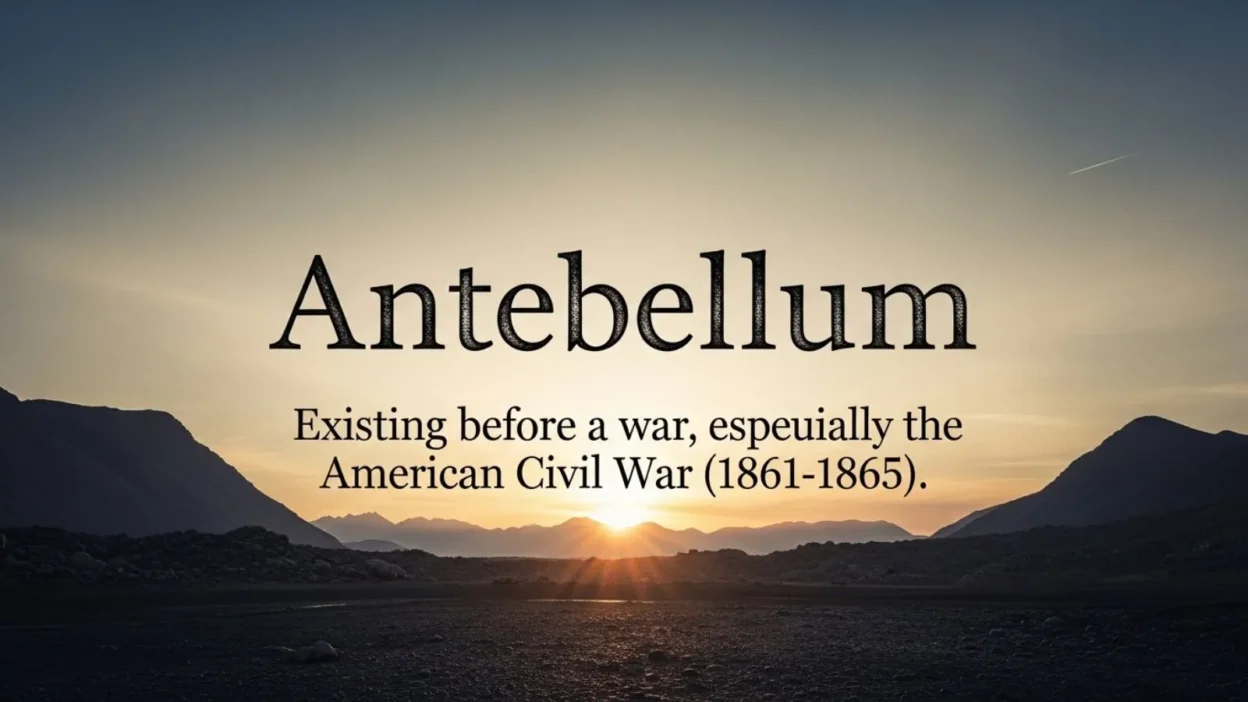
The word Antebellum may sound unfamiliar to some, but it carries significant historical and cultural weight. Derived from the Latin words ante meaning before and bellum meaning war, antebellum literally translates to before the war.
In English, the term is most commonly associated with the period in American history leading up to the Civil War, particularly in the Southern United States.
During this time, the nation grappled with complex social, economic, and political tensions, including the widespread use of slavery, the growth of plantations, and the rise of sectional conflicts.
Understanding the meaning of antebellum goes beyond simple translation it offers insight into an era that shaped modern American society, culture, and architecture.
In this article, we will explore the definition, historical context, cultural significance, architectural style, and modern usage of antebellum, helping readers fully grasp why this term remains relevant today.
What Does Antebellum Mean?
The term “antebellum” originates from Latin, where ante means “before” and bellum means “war.” Put together, it literally translates to “before the war.” In English, the word is used both literally and contextually. Literally, it can describe any period preceding a war, not necessarily tied to the United States. However, in most modern contexts, antebellum is closely associated with the years leading up to the American Civil War (roughly late 18th century to 1861).
When people refer to the antebellum era in the U.S., they often mean the Southern states before the Civil War, highlighting the society, economy, and culture that existed during this period. The antebellum South was marked by large plantations, the use of enslaved labor, and a hierarchical social system. Because of this, the word “antebellum” has also taken on a cultural and historical dimension, representing a specific way of life and architectural style.
Outside of historical references, antebellum can appear in literature, academic writing, and even modern discussions, often to set a time frame or to describe something reminiscent of that era. For example, one might refer to a grand Southern mansion as “antebellum architecture” or describe a pre-war social structure as “antebellum society.” Understanding its dual usage—literal and historical—is essential for using the term correctly in conversation and writing.
Historical Context of the Antebellum Period
The antebellum period in American history refers to the years roughly between the late 18th century and 1861, just before the outbreak of the Civil War. This era was defined by rapid economic growth, social change, and deep political tensions, particularly in the Southern United States. The Southern economy relied heavily on agriculture, with cotton, tobacco, and rice plantations forming the backbone of wealth and trade. This economic model depended on the labor of enslaved African Americans, making slavery a central and deeply divisive issue.
Politically, the antebellum period was marked by increasing sectionalism, as Northern and Southern states grew apart in their economic interests and social values. Debates over slavery, states’ rights, and territorial expansion fueled tensions that would eventually erupt into the Civil War. During this time, the Missouri Compromise, the Compromise of 1850, and the Kansas-Nebraska Act were significant events that attempted, unsuccessfully, to balance the interests of free and slave states.
Culturally, the antebellum era shaped Southern society, emphasizing hierarchy, landownership, and tradition. Literature, music, and social customs reflected these values while also exposing the harsh realities of slavery and oppression. Understanding the historical context of the antebellum period is crucial, as it allows us to see why the term has strong associations not only with a time frame but also with a complex social and political system. This background sets the stage for exploring antebellum culture, architecture, and its lasting impact on American history.
Social and Cultural Aspects of the Antebellum Era
The antebellum era was not only a time of economic and political tension but also a period defined by distinct social and cultural characteristics, especially in the Southern United States. Society during this period was highly hierarchical, with wealthy plantation owners occupying the top tier, followed by small farmers, artisans, and poor whites. At the bottom of this hierarchy were enslaved African Americans, who were denied basic rights and subjected to harsh labor and living conditions. This rigid social structure shaped nearly every aspect of daily life, from education and recreation to family dynamics and public behavior.
Culturally, the antebellum South was steeped in tradition and ceremony, emphasizing manners, hospitality, and social status. Literature and music of the period often reflected these values while occasionally grappling with the moral and human complexities of slavery. Religion played a central role in daily life, both among white Southerners and enslaved communities, influencing customs, festivals, and community gatherings.
Despite the romanticized image of Southern society seen in modern media, the antebellum period was also marked by tensions and inequalities. Enslaved people resisted oppression through subtle acts of defiance, storytelling, and the preservation of cultural practices, which contributed to a rich cultural legacy. Understanding the social and cultural aspects of the antebellum era provides deeper insight into how history, economics, and power shaped society, and why the period remains a pivotal chapter in American cultural memory.
Antebellum Architecture and Design
One of the most enduring symbols of the antebellum era is its distinctive architecture, which continues to captivate historians, architects, and tourists alike. Antebellum architecture refers primarily to the grand homes and public buildings constructed in the Southern United States before the Civil War. These structures were often plantation houses, built to display wealth, power, and social status. Common architectural features include large columns, symmetrical facades, expansive porches, and high ceilings, reflecting influences from Greek Revival and Neoclassical styles.
The design of these buildings was not only aesthetic but also practical. High ceilings, wide verandas, and large windows allowed for better ventilation in the hot Southern climate. Interiors often featured spacious rooms, ornate staircases, and formal parlors, designed for hosting social gatherings and entertaining guests. These architectural elements emphasized order, elegance, and sophistication, mirroring the social hierarchy of the time.
Beyond residential homes, antebellum architecture also influenced churches, courthouses, and other civic buildings, contributing to a distinctive regional style that is recognized even today. Many of these structures have been preserved or restored, serving as tourist attractions and historical sites, offering a glimpse into Southern life before the Civil War.
Understanding antebellum architecture provides insight into the cultural values, wealth distribution, and lifestyle of the period. It reflects a society that valued grandeur and tradition while also highlighting the stark contrast between the lavish homes of the elite and the harsh realities faced by the enslaved population who built and maintained them.
Economic and Political Context of the Antebellum Period
The antebellum period was shaped by a complex interplay of economic and political factors that defined life in the Southern United States and fueled tensions that eventually led to the Civil War. Economically, the South relied heavily on agriculture, with cotton emerging as the dominant cash crop after the invention of the cotton gin in the late 18th century. Plantations became the center of wealth and social influence, but this prosperity depended almost entirely on the labor of enslaved African Americans, creating an economy deeply intertwined with slavery. Small farmers and poor whites participated in this agricultural system, but few enjoyed the wealth or influence of plantation owners.
Politically, the antebellum era was marked by sectionalism—the growing division between the North and South. Northern states were rapidly industrializing, while the South remained largely agrarian. Disputes over states’ rights, territorial expansion, and the legality of slavery in new territories sparked heated debates in Congress and society. Key legislative events, such as the Missouri Compromise, the Compromise of 1850, and the Kansas-Nebraska Act, attempted to balance the interests of free and slave states but ultimately deepened divisions.
The political and economic realities of the antebellum period were inseparable. Southern wealth, social hierarchy, and political power depended on a system built on slavery, while Northern industrial growth and moral opposition to slavery created mounting conflict. Understanding this context is essential to comprehending why the antebellum period was both prosperous and deeply unstable, setting the stage for one of the most transformative chapters in American history.
Antebellum in Modern Usage
While the term “antebellum” originally referred to the period preceding the American Civil War, its use has expanded in modern language and culture. Today, the word is often used to describe anything reminiscent of the pre-Civil War era, particularly in the Southern United States. For example, historians and writers may refer to antebellum architecture, lifestyle, or social norms when discussing cultural or historical subjects. Similarly, the term can appear in literature, films, or academic works to evoke a specific historical atmosphere or social context.
Beyond historical writing, “antebellum” is sometimes used metaphorically to describe a period preceding any significant conflict or upheaval, not just the Civil War. For instance, one might speak of an “antebellum period” in economic, political, or social terms to indicate a calm before a major change or crisis. This broader application demonstrates the word’s flexibility while maintaining its core meaning: “before the war.”
However, it’s important to use the term accurately. Misapplication can lead to confusion, especially in historical discussions. Using “antebellum” correctly involves acknowledging both the literal translation and the cultural-historical context, particularly when referencing the American South.
Understanding how the word is employed today provides insight into how history influences language and perception. It allows us to appreciate not only the literal meaning of “antebellum” but also its continuing relevance in describing heritage, architecture, society, and the legacies of a formative period in U.S. history.
Examples of Antebellum in Sentences
Understanding the word “antebellum” becomes much easier when seen in context. Here are several examples that illustrate its usage in historical, cultural, and modern settings:
- Historical context:
The antebellum South was characterized by large plantations, an agricultural economy, and the widespread use of enslaved labor.” - Architectural reference:
The mansion’s grand columns and symmetrical facade are typical of antebellum architecture. - Literary usage: The novel explores antebellum society, highlighting both the elegance of the planter class and the harsh realities of slavery.
- Metaphorical use:
The nation experienced an antebellum period of political tension before the outbreak of the civil conflict. - Cultural discussion:
Antebellum traditions influenced Southern music, dance, and social customs that are still celebrated in some communities today.” - Modern commentary:
Tourists visiting Savannah often admire the beautifully preserved antebellum homes that reflect the city’s rich history. - Academic reference:
Students study the antebellum era to understand the social and political factors that led to the Civil War.
These examples demonstrate that antebellum is versatile but always tied to the idea of a period before a major war or upheaval. Using it correctly requires understanding both the literal Latin meaning (‘before the war’) and its historical application in the American South, particularly before 1861.
By seeing how antebellum functions in sentences, readers can grasp its nuances and apply the term accurately in writing or conversation, whether describing history, architecture, culture, or metaphorical pre-war periods.
Why Understanding Antebellum Matters
Grasping the meaning and significance of antebellum is important for several reasons, both historically and culturally. At its core, the term refers to a period before the Civil War, but it also embodies the social, economic, and political realities of the time. Understanding antebellum history allows us to appreciate how the Southern United States developed its unique culture, traditions, and architecture, as well as the profound impact of slavery on society.
Studying the antebellum era also provides insight into the roots of modern American conflicts and debates. Many issues from that period, including racial inequality, economic disparity, and states’ rights, continue to influence American society today. By learning about antebellum social structures, politics, and cultural practices, we can better understand the historical context behind contemporary discussions on civil rights, heritage preservation, and cultural memory.
Moreover, knowledge of antebellum history helps in accurately using the term in literature, education, and conversation. Misunderstanding it can lead to confusion or oversimplification of a complex era. Whether discussing antebellum architecture, society, or broader pre-war periods, using the term correctly reflects a deeper awareness of history.
In essence, understanding antebellum is not just about knowing a word—it’s about recognizing a pivotal era that shaped the United States, appreciating its cultural legacy, and learning lessons from its social and political struggles. This awareness enriches both historical literacy and cultural sensitivity, making the study of antebellum essential for students, writers, and curious readers alike.
Frequently Asked Questions About Antebellum
1. What era does “antebellum” refer to?
The term “antebellum” literally means “before the war”. In American history, it specifically refers to the period before the Civil War, roughly from the late 18th century to 1861.
2. Is antebellum only associated with the Southern United States?
While the term can be used more generally to describe any pre-war period, in the U.S., it is most commonly associated with the Southern states. This is due to the region’s unique social, economic, and cultural characteristics during that era, including plantations, slavery, and agrarian society.
3. Can antebellum refer to wars other than the U.S. Civil War?
Yes. The literal Latin meaning allows it to describe any period preceding a war, although in practice, it is most often used in reference to the American Civil War and its cultural and historical context.
4. How do you pronounce “antebellum”?
It is pronounced an-teh-BELL-um, with the emphasis on the second syllable.
5. Why is understanding the term antebellum important today?
Understanding antebellum helps us grasp historical context, including social hierarchies, politics, and culture of the pre-Civil War South. It also allows for accurate use in writing, literature, and discussions about architecture, society, and history. Misusing the term can oversimplify or misrepresent a complex period that had lasting effects on American society.
Conclusion:
The term Antebellum is more than just a historical label it is a window into a trans formative era of American history.
Literally meaning before the war, it most often refers to the period in the Southern United States preceding the Civil War, a time marked by plantations, slavery, social hierarchy, and political tension.
Understanding antebellum allows us to appreciate the cultural, architectural, and social aspects of this era, from grand Southern mansions to daily life and customs that shaped the region.
Beyond historical study, the word retains relevance in modern language, literature, and cultural discussions, providing a framework to describe periods of calm before major conflict or to reference Southern heritage and architecture.
By learning the true meaning, context, and proper usage of antebellum, readers can gain a deeper understanding of history, culture, and language, and better appreciate how the legacies of the past continue to influence society today.

The author behind RiddleBurst.com loves creating fun, clever, and unique riddles for all ages. Their goal is to challenge minds, bring smiles, and make learning through riddles both engaging and enjoyable.